Southeast Lens - Documentation, Travel and Street Photography

Behind the Lens, Frame by Frame
Every photograph has a story. Here, I take you behind the image — from the moment I saw it to the decisions that shaped the final frame.
Hanoi Train Street — The Train Comes Through Whether You're Ready or Not
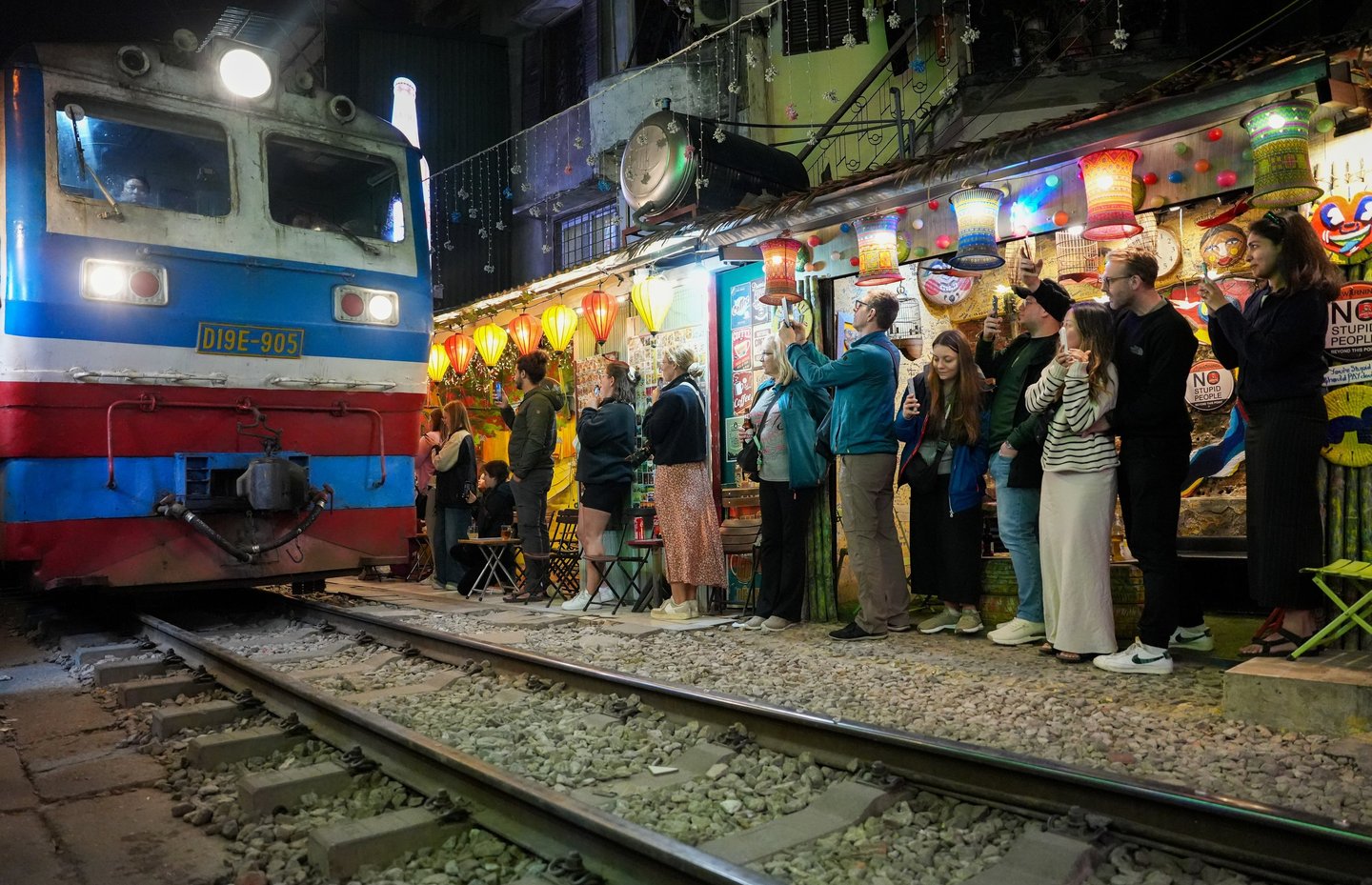
A blue and red locomotive, number DI9E-905, headlights burning, filling the left side of the frame — and on the right, a line of tourists pressed flat against the lantern-decorated café fronts, phones up, nobody moving. The gap between the train and the people is smaller than it looks in the photo.
This is Hanoi Train Street in the Old Quarter. And it's exactly as tight as it sounds.
I've been to a lot of locations across Southeast Asia that get called unmissable. Most of them are overstated. This one isn't. Tucked into a narrow residential alley of the Hanoi Old Quarter, what started as a basic rail line built during the French colonial era has turned into one of the most surreal street photography locations in Vietnam. The North-South Railway still runs through here — linking Hanoi to Ho Chi Minh City — and the trackside cafés, lanterns, souvenir stalls and improvised kitchens have grown right up to the edge of the rails over decades.
No travel blog fully prepares you for standing there when it actually comes through.
I shot this on the Sony Alpha 7 IV with the FE 24-70mm f/2.8 GM II at 24mm — wide enough to get the full locomotive and the full line of people in one frame without stepping back into the tracks. f/2.8 to separate the lit café fronts from the dark alley behind. 1/400 to freeze the train dead sharp despite the low light. ISO 6400 on the A7 IV — the files held clean, which at this shutter speed in near-darkness is exactly what you need from your sensor.
The timing window is short. The train slows but doesn't stop. You have maybe 20 seconds from when you hear it coming to when it's past you. I had one pass to get this frame.
What I find interesting about this location isn't the train itself — it's the people watching it. Look at the faces in this shot. Some are filming. Some are just standing there taking it in. One woman near the front isn't even looking at the train — she's looking at the person next to her. That's the real photograph inside the photograph.
Hanoi Train Street gets busy. Go at night for the lantern light. Arrive early, find your position, and wait. The train schedule is loose — ask the café owners, they know it better than any app.
📍 Hanoi Train Street, Old Quarter, Hanoi, Vietnam
📷 Sony Alpha 7 IV · FE 24-70mm f/2.8 GM II · 24mm · f/2.8 · 1/400s · ISO 6400
Hanoi Old Quarter: Colonial Buildings, Street Kitchens, and the Noise of Everything at Once
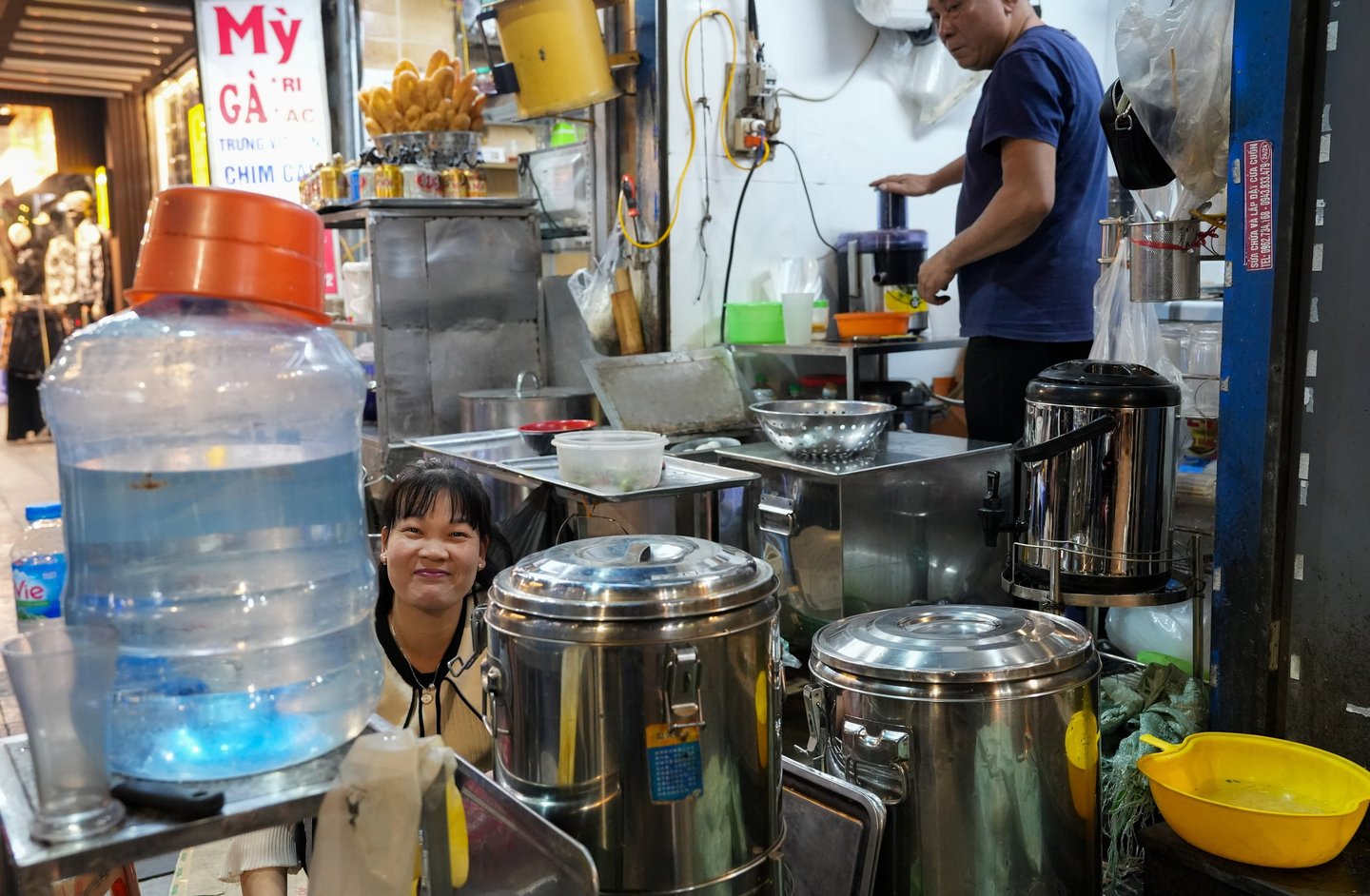
If you want to understand how Vietnam actually works, skip the monuments. Go to the Hanoi Old Quarter and watch what happens on the pavement.
One moment I'm standing in front of a makeshift street kitchen — massive soup pots boiling directly on the sidewalk. Three metres further, a colonial building converted into a coffee bar, packed with locals and travellers sitting out the evening over a Vietnamese iced coffee. No transition, no signpost. It just happens.
This is the frame I was looking for.
A street kitchen squeezed into a tight alcove. Large stainless steel broth vats in the foreground, a blue water jug beside them, a woman sitting wedged between the equipment looking straight into my lens — no posed smile, just real Hanoi. Behind her a man works a juicer, surrounded by fresh baguettes and colourful plastic gear. Bánh mì and broth, side by side, in a space that's technically too small for both.
For this kind of low-light street scene you need gear that reacts instantly without killing the atmosphere. I shot this handheld on the Sony Alpha 7 IV with the FE 24-70mm f/2.8 GM II.
34mm — right for tight street corridors in the Old Quarter.
f/4.0 — enough depth to keep the whole scene sharp.
1/160s — fast enough to freeze the small movements.
ISO 5000 — the A7 IV pulls clean files out of deep evening shadows.
Hanoi doesn't work to a schedule. You plant yourself somewhere, wait, and let the street come to you. The Old Quarter is one of the densest street photography locations in Southeast Asia — old traditions and modern life running simultaneously on every single corner.
📍 Hanoi Old Quarter, Vietnam
📷 Sony Alpha 7 IV · FE 24-70mm f/2.8 GM II · 34mm · f/4.0 · 1/160s · ISO 5000
Soi Buakhao at 4:00 AM — This Is What Pattaya Looks Like When Almost Everyone Has Gone Home
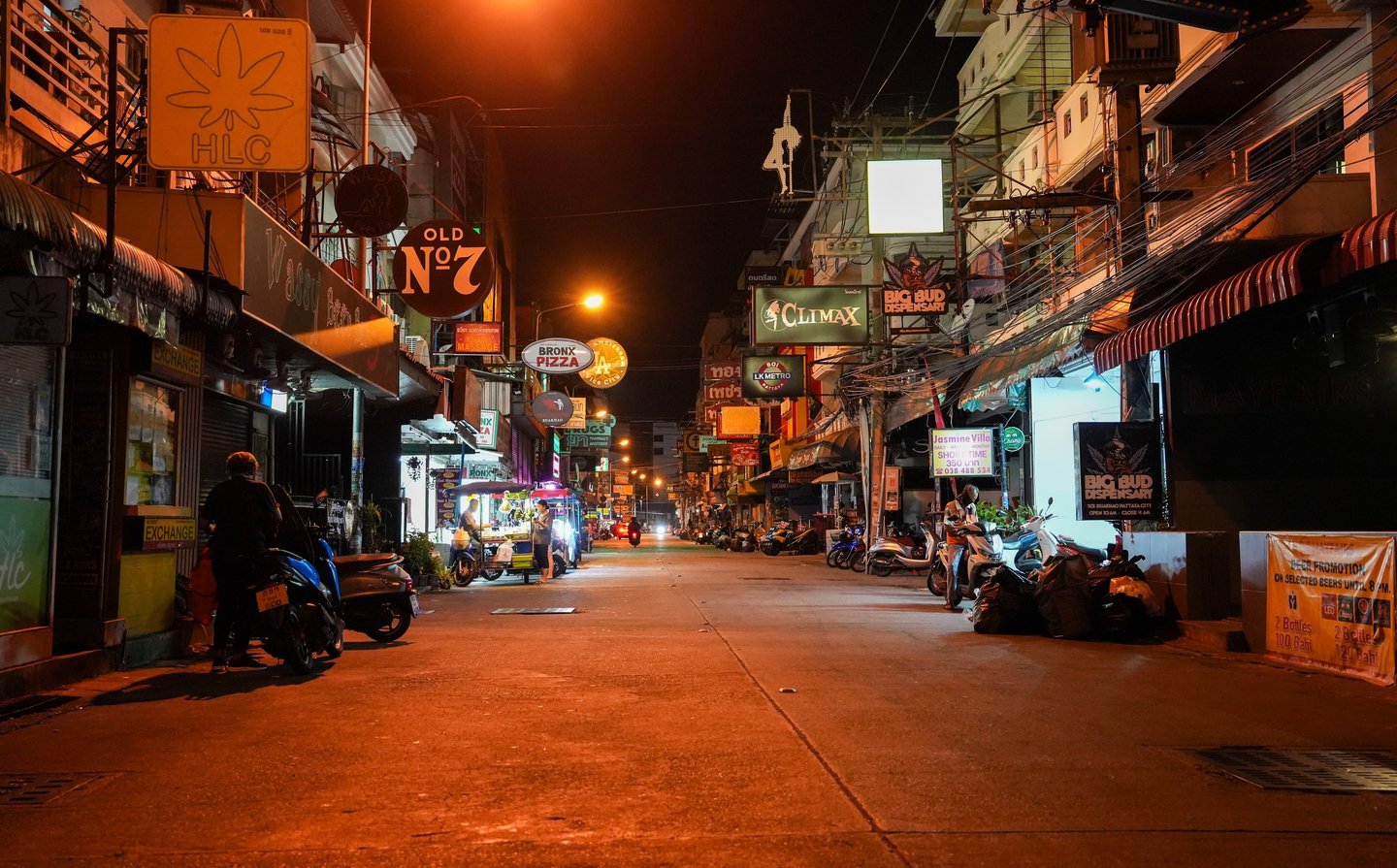
Old No.7 bar sign glowing orange on the left, Bronx Pizza, Climax, Big Bud Dispensary — signs stacked in every direction along Soi Buakhao, the street nearly empty, one motorbike headlight coming down the middle, rubbish bags piled on the right kerb, a lone figure standing next to a parked bike on the left. The street food stall at the far end still has its lights on.
This is Soi Buakhao at 4am. Not the version most people see.
I headed out at 3:30am with the Sony Alpha 7 IV and the FE 24-70mm f/2.8 GM II. This hour requires patience and the right settings. f/4.0 to keep the street readable front to back without losing the ambient orange glow. 1/30 to hold the neon and the sodium streetlight without going too soft on the static elements. ISO 5000 — the A7 IV at this level is clean enough to work with straight out of camera. 35mm to keep the full width of Soi Buakhao in frame without distorting the signs on either side.
The shot is about what's missing as much as what's there. Six hours earlier this strip is shoulder to shoulder. Now it's one motorbike and the sound of a few bar stools scraping inside somewhere.
I focus on these quiet moments before dawn on purpose. The night owls still out at this hour aren't performing for anyone. The vendor with her stall half-packed isn't there for the tourists. The small groups finishing their last drink inside the open bars — they're just not ready to let the night end yet.
Soi Buakhao never fully switches off. It just gets quieter. And that's when it gets honest.
If you think you know this street from the daytime or the early evening — come back at 4am. Bring a camera with a sensor that handles high ISO. And don't rush the shot.
📍 Soi Buakhao, Pattaya City, Thailand
📷 Sony Alpha 7 IV · FE 24-70mm f/2.8 GM II · 35mm · f/4.0 · 1/30s · ISO 5000
When the neon fades: Capturing Pattaya’s raw, unfiltered 4:00 AM street life.
Most people know this city for its wild, high-energy nightlife, but the real magic for a documentary photographer happens when the music stops. If you want to understand the true pulse of Pattaya City Thailand, you have to explore the streets during the quiet moments before dawn.
At about 3:30 a.m., I headed out into the humid night air to document the shifting atmosphere around the famous nightlife districts. Even at this late hour, when the massive crowds have cleared, you still find the night owls, street vendors, and wandering souls who keep the city breathing.
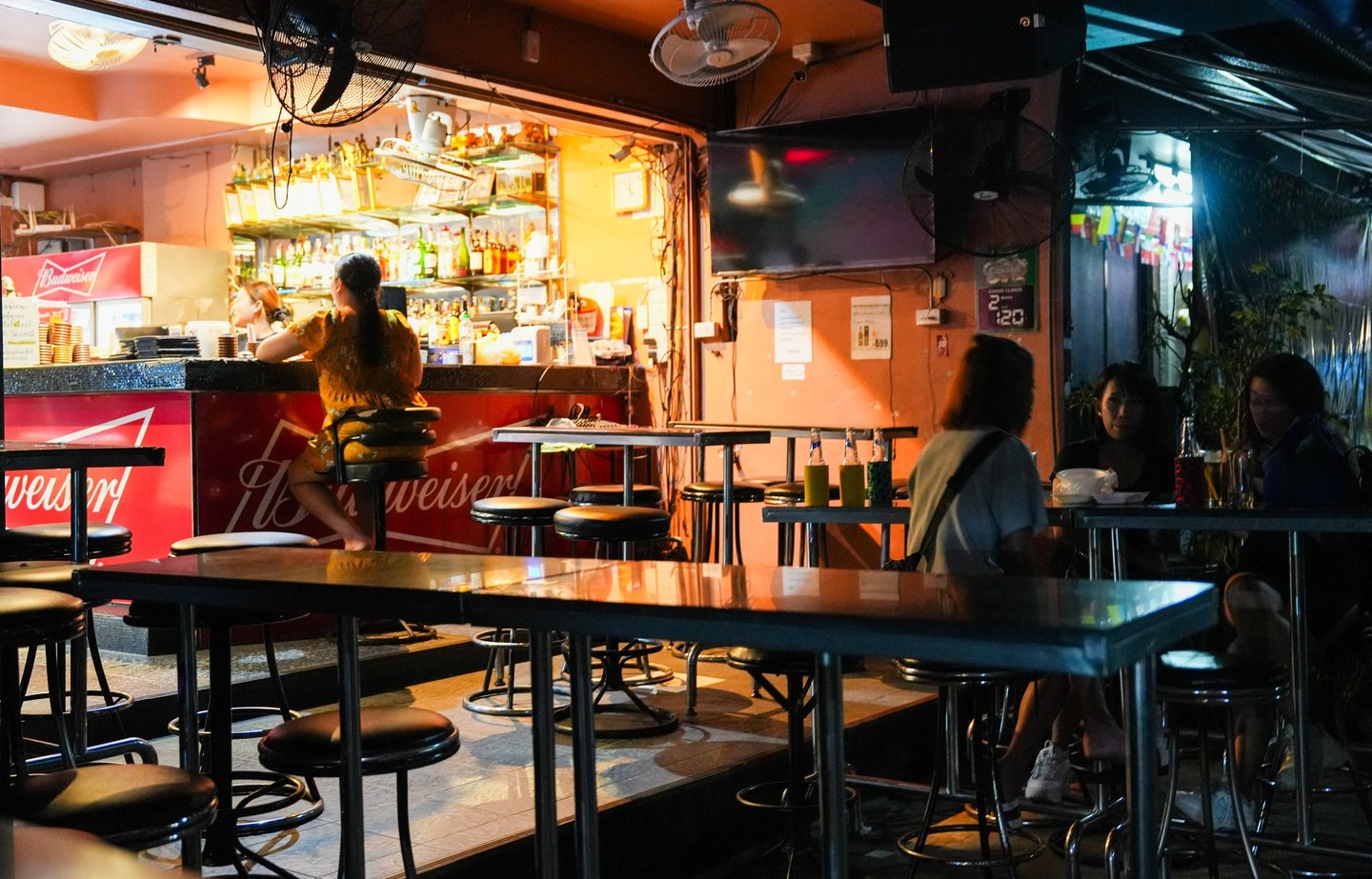
Walking near Soi Buakhao, I captured this unposed slice of Pattaya street life inside a local beer bar at LK Metro. Inside the open-front venue, a small group of people are finishing their drinks, not quite ready to go home yet. A woman in a yellow dress sits at the vibrant red bar under warm, golden interior lighting, while a few remaining customers chat quietly at the high tables, surrounded by empty stools and cooling fans. It’s a gritty, authentic scene that anyone interested in Thailand travel photography or the local subculture will instantly recognize.
Documenting low-light street scenes without ruining the ambient mood requires gear that reacts instantly. For my fellow Sony Alpha photography enthusiasts, I shot this handheld using my trusted Sony Alpha 7 IV paired with the Sony FE 24-70mm f/2.8 GM II lens. To balance the bright bar lights with the deep shadows of the alley, I dialed in these specific manual settings:
Focal Length: 40mm (ideal for natural street perspective)
Aperture: f/3.2
Shutter Speed: 1/10s (steady hands required to pull in the light)
ISO: 5000
For Pattaya and Thailand experts, business owners, and passion-driven creators who know the city inside out, these early hours reveal a completely different landscape. It’s a side of nightlife in Thailand that rarely makes it into tourist brochures—raw, quiet, and completely real
This Isn't a Street. It's a Restaurant. — And Nobody Here Sees Anything Unusual About That.
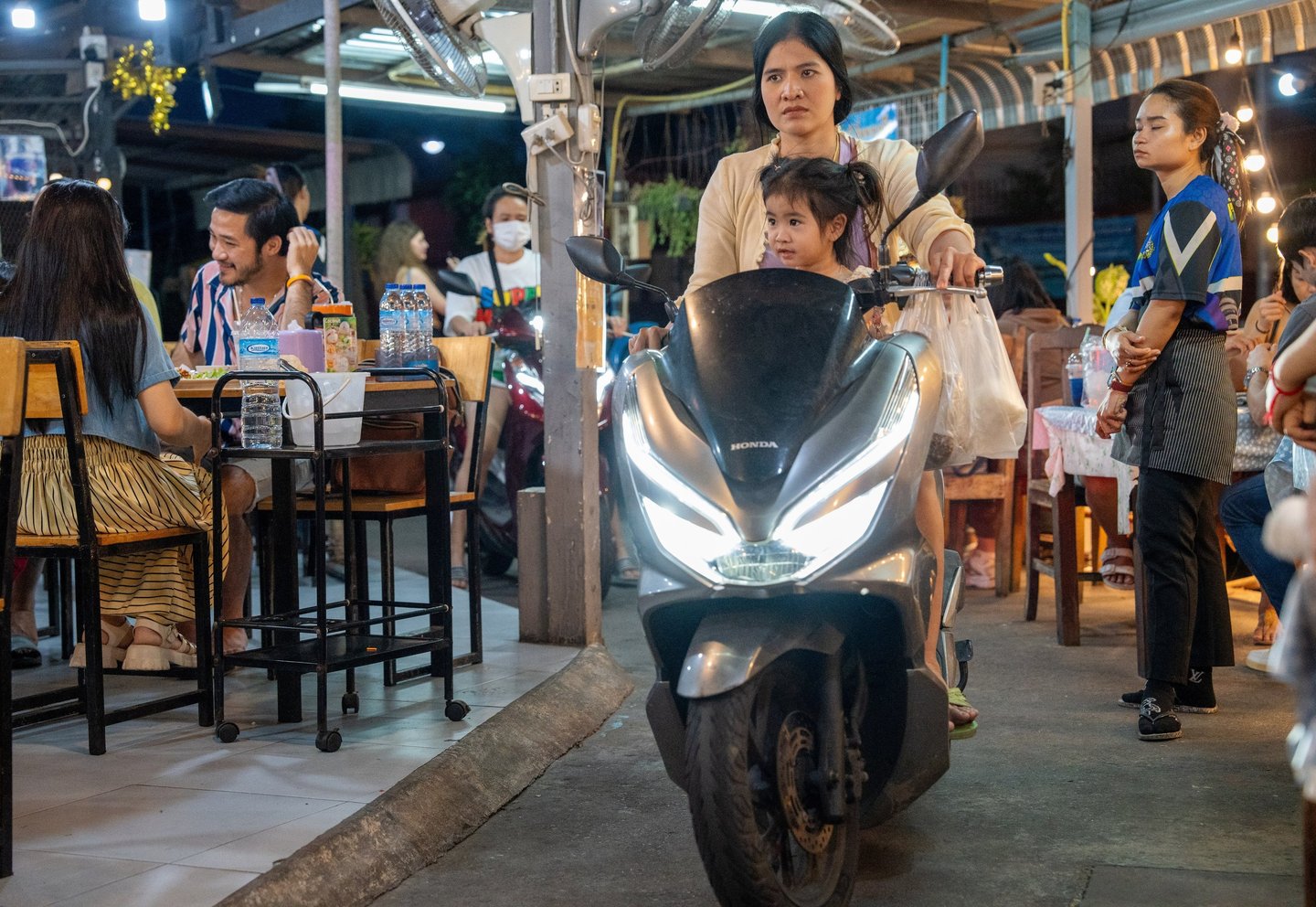
A mother on a Honda PCX with her young daughter sitting on the front, headlight on, threading straight through the middle of a packed open-air restaurant in Naklua, Pattaya. Diners on the left mid-conversation, a waitress on the right not even looking up, tables on both sides, string lights overhead — and a motorbike coming straight through the middle of it all.
Nobody moved. Nobody reacted. This is just how the evening works here.
The passage through the restaurant is the street. The street is the restaurant. In Naklua, that line doesn't exist.
I was standing at the far end, framing the shot as the PCX came towards me — headlight straight at the lens, the little girl looking directly at me from the front of the bike, the mother focused on the gap between the tables. I had one pass. 60mm on the Sony Alpha 7 IV with the FE 24-70mm f/2.8 GM II. f/3.5 to keep both the bike and the dining room behind it in the frame. 1/320 to freeze the motion completely — at this shutter speed the headlight still reads as a hard point of light rather than a smear. ISO 5000, available light only, no flash.
The shot needed to be taken from the front. Any other angle and you lose the headlight, you lose the girl's expression, and you lose the sense that this thing is actually moving through a room full of people eating dinner.
This is Naklua — ten minutes north of Walking Street, a completely different Pattaya. No bar strip, no tourist menus, no performance for visitors. Just local families eating out on a regular evening, and a Honda PCX that needs to get through.
I've walked this area a lot. The photographers who stay on Walking Street and Jomtien miss the best material. Come north. Eat here. Bring a camera with a sensor that handles mixed artificial light at high ISO.
Thailand doesn't arrange itself for the camera. You either see it or you don't.
📍 Naklua, Pattaya, Thailand
📷 Sony Alpha 7 IV · FE 24-70mm f/2.8 GM II · 60mm · f/3.5 · 1/320s · ISO 5000
The Bridge on the River Kwai — A Train Still Crosses It Every Day, Thailand
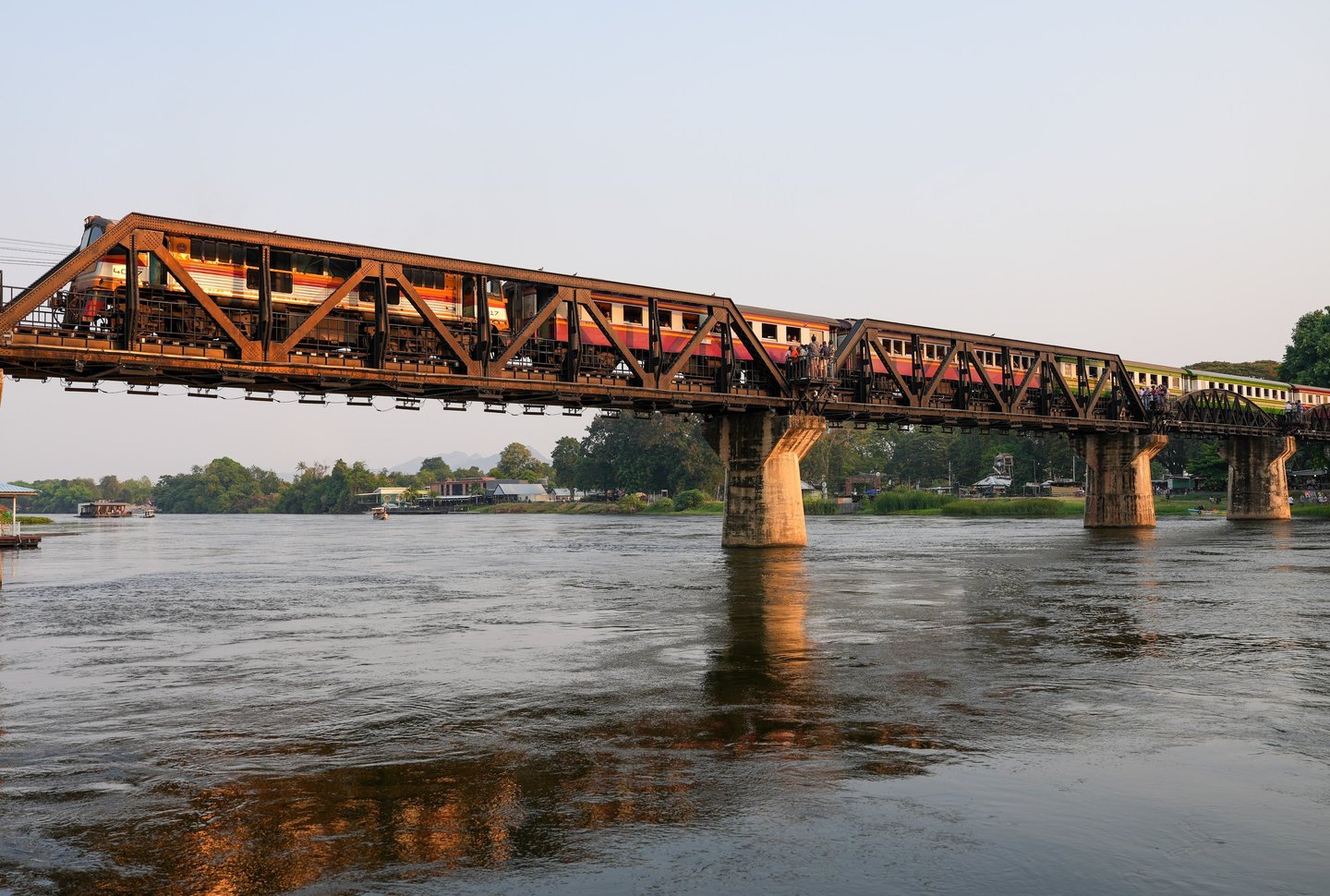
A Thai Railways passenger train crossing the Bridge on the River Kwai in the late afternoon light — pink and orange carriages moving across the original steel truss spans, people standing on the open walkways on either side watching the water below, the Kwai Yai River reflecting the warm golden hour sun off the concrete piers. Kanchanaburi, western Thailand.
This bridge is still a working railway crossing. That's what most people don't expect when they arrive.
Built between 1942 and 1943 by Allied prisoners of war under Japanese occupation during World War II, the Burma-Thailand Railway — known as the Death Railway — ran 415 kilometres through some of the most difficult terrain in Southeast Asia. An estimated 100,000 Asian labourers and over 12,000 Allied POWs died during its construction. The bridge at Kanchanaburi is the section that survived. The round steel spans you see in most photographs are actually post-war replacements — the originals were destroyed by Allied bombing in 1945. The angular spans in the middle are the originals.
Historical side note: The original, very first bridge at this location was actually a pure wooden structure, built about 100 meters upstream parallel to today’s steel bridge. However, virtually nothing remains of this wooden bridge today.
I shot this from the riverbank, 28mm on the Sony Alpha 7 IV with the FE 24-70mm f/2.8 GM II. Wide enough to get the full length of the bridge and its reflection in the river without losing the train. f/5.0 to keep the steel structure sharp front to back. 1/250 to freeze the train cleanly against the sky. ISO 100 — late afternoon sun was still strong enough to shoot at base ISO and keep the files completely clean.
The timing matters here. The train crosses twice daily. I waited on the bank for the afternoon crossing and shot into the light as it moved across the span. The warm reflection in the Kwai below gave me the colour the flat sky wasn't offering.
Most visitors to Kanchanaburi walk the bridge on foot — which you should do — but the photograph is from the water level, not on top of it. Get down to the riverbank early, find your position, and wait for the train.
The Bridge on the River Kwai is two hours from Bangkok by train from Thonburi station. Most Thailand itineraries skip it entirely. That's a mistake. This is one of the most historically significant sites in all of Southeast Asia, and it's still running trains across the river that witnessed all of it.
Bridge on the River Kwai, Kanchanaburi, Thailand
Sony Alpha 7 IV · FE 24-70mm f/2.8 GM II · 28mm · f/5.0 · 1/250s · ISO 100
Beyond the Postcard: The Karen Long Neck Tribe in Northern Thailand
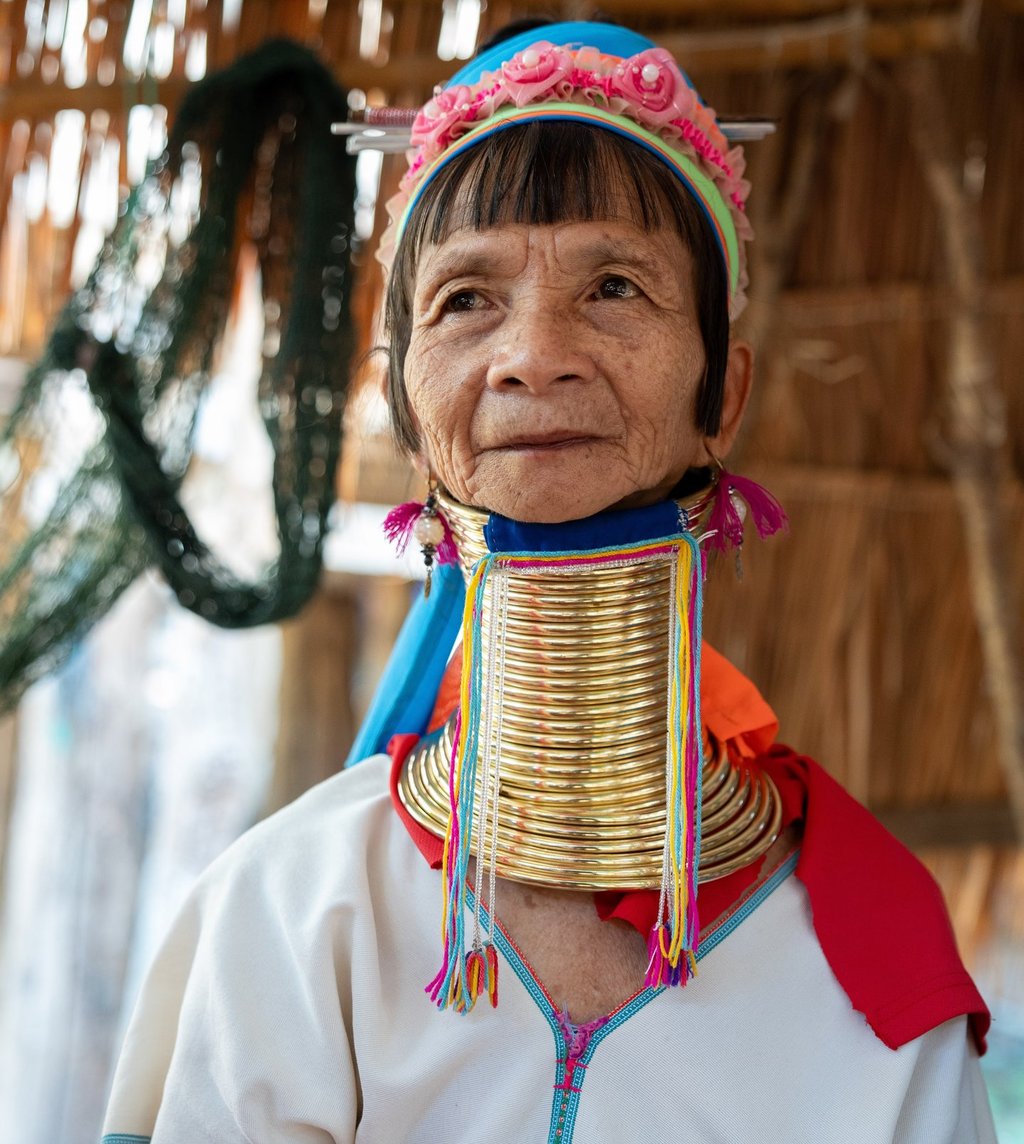
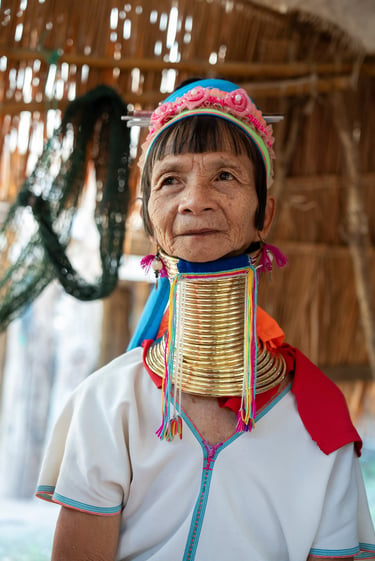
Most images coming out of Northern Thailand show the brass coils and stop there. I wanted to understand what's actually behind them.
The Portrait
An elderly Kayan Lahwi woman standing under a shelter of woven straw and bamboo, traditional white clothing with red accents, a colourful headdress with pink flowers, heavy polished brass coils wrapped around her neck with woven tassels hanging down the front. She looked directly into the lens and didn't move.
I didn't direct anything. That expression was already there.
The Brass Coils — What They Actually Are
For the Kayan people, a subgroup of the Red Karen, the coils start at around age five. The common assumption is that they stretch the neck. They don't. The weight of the brass pushes down on the collarbone and ribcage, compressing the chest and creating the visual illusion of an elongated neck.
Why? The origins vary depending on who you ask. Some tribal elders say the coils originally protected women from tiger attacks in the jungle. Others say it was a deliberate measure to make women less attractive to slave traders from rival tribes. Today it's a marker of cultural identity, tribal beauty, and increasingly — income.
The Political Reality
For anyone who knows Thailand beyond the tourist trail, the presence of these villages near Chiang Mai is the direct result of a brutal conflict that's still unresolved. The Karen people are ethnic minorities who fled decades of military oppression, forced labour, and civil war in Myanmar.
They crossed into Thailand seeking asylum. But their legal status here remains precarious. Many living in these villages are classified as refugees — limited rights, restricted movement, no pathway to Thai citizenship. They exist in a political limbo, dependent on the tourism revenue that their own cultural display generates, while trying to keep that culture from being reduced entirely to a commercial transaction.
That tension is visible if you spend enough time there and look past the entrance fee.
The Settings
Shaded bamboo interiors with low ambient light require a setup that can isolate a subject without losing the texture of what they're wearing. I shot this handheld on the Sony Alpha 7 IV with the FE 24-70mm f/2.8 GM II.
50mm — the closest focal length to natural human perspective for a portrait.
f/2.8 — wide open to separate her from the busy straw background.
1/100s — fast enough to counter handheld movement without going too slow.
ISO 1600 — pulling in clean ambient light under the roof without introducing noise.
The A7 IV at ISO 1600 in shade gives you files that hold the detail in the brass and the fabric simultaneously. That matters in a frame like this.
Documentary photography in communities like this carries a responsibility that goes beyond the technical. The goal is to show the person in front of you exactly as they are — not as the attraction the entrance fee suggests they should be.
Karen Long Neck Village, Chiang Mai Province, Thailand
Sony Alpha 7 IV · FE 24-70mm f/2.8 GM II · 50mm · f/2.8 · 1/100s · ISO 1600
The Real Boss of Bui Vien Walking Street in Saigon, Vietnam — And She Wasn't Taking Any Nonsense
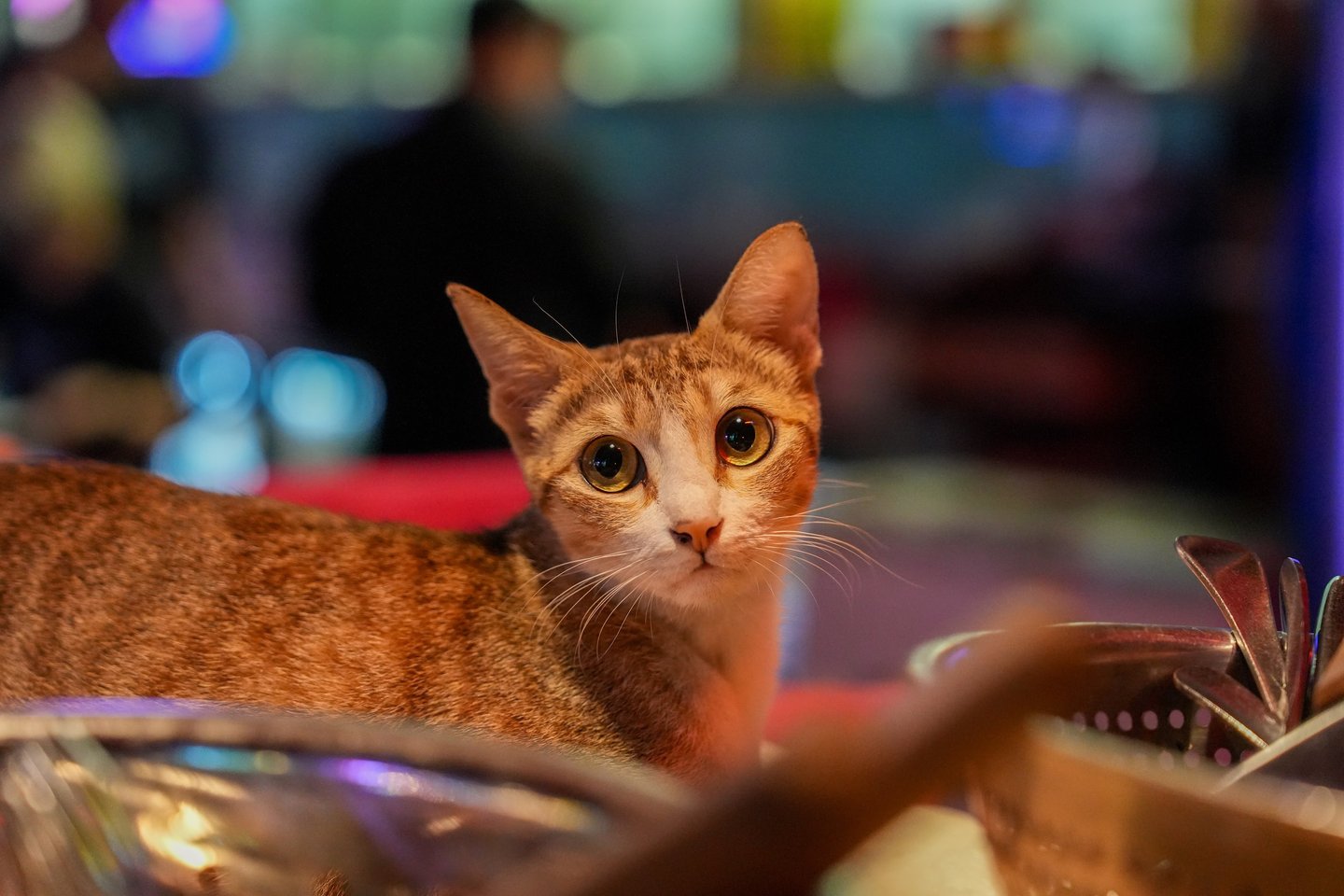
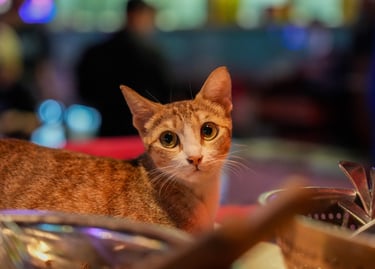
A ginger cat on the bar counter, yellow-green eyes wide open, staring straight at the camera — completely calm, completely in charge. Bui Vien Walking Street, Saigon, sometime after midnight.
We were sitting outside at a bar on Bui Vien that night, cold drinks, a live band playing behind us, the neon of Ho Chi Minh City doing its thing in every direction. Good evening. The kind that turns into a late one without you noticing.
At some point I went inside to order and found her. Stretched out on the bar counter, watching everything happening around her with the kind of patience that suggests she'd seen it all before and wasn't impressed. The bartender worked around her. The customers worked around her. Nobody questioned it.
She owned the place. That was just understood.
I put the Sony Alpha 7 IV on the counter at her level, FE 24-70mm f/2.8 GM II pulled to 70mm to compress the background and get just her face filling the frame. f/2.8 wide open — the bar bokeh behind her, blue and red neon bleeding into soft circles, the counter edge coming in soft from the foreground. 1/320 to freeze any movement completely. ISO 6400, the mixed artificial light of a Bui Vien bar at night, and the A7 IV handling it without a problem.
The eyes are the shot. At 70mm and f/2.8, those yellow-green eyes are tack sharp while everything behind her dissolves. That's the only way this frame works.
She didn't move while I shot. She looked directly at the lens for about thirty seconds, then turned her head away as if she'd given me enough time and had other things to think about.
Fair enough.
Bui Vien Walking Street is one of the loudest, most neon-saturated streets in Southeast Asia. A packed pedestrian zone in District 1, Ho Chi Minh City, running between Pham Ngu Lao and De Tham — live music, street food, bars open until the crowd finally runs out. The cat on the counter inside one of those bars was, without question, the calmest thing on the entire street that night.
Best subject I photographed in Saigon. No contest.
Bui Vien Walking Street, District 1, Ho Chi Minh City, Vietnam
Sony Alpha 7 IV · FE 24-70mm f/2.8 GM II · 70mm · f/2.8 · 1/320s · ISO 6400
The Thai Train Driver Who Decided to Moonlight as a Tomato Courier — And Nobody Batted an Eye
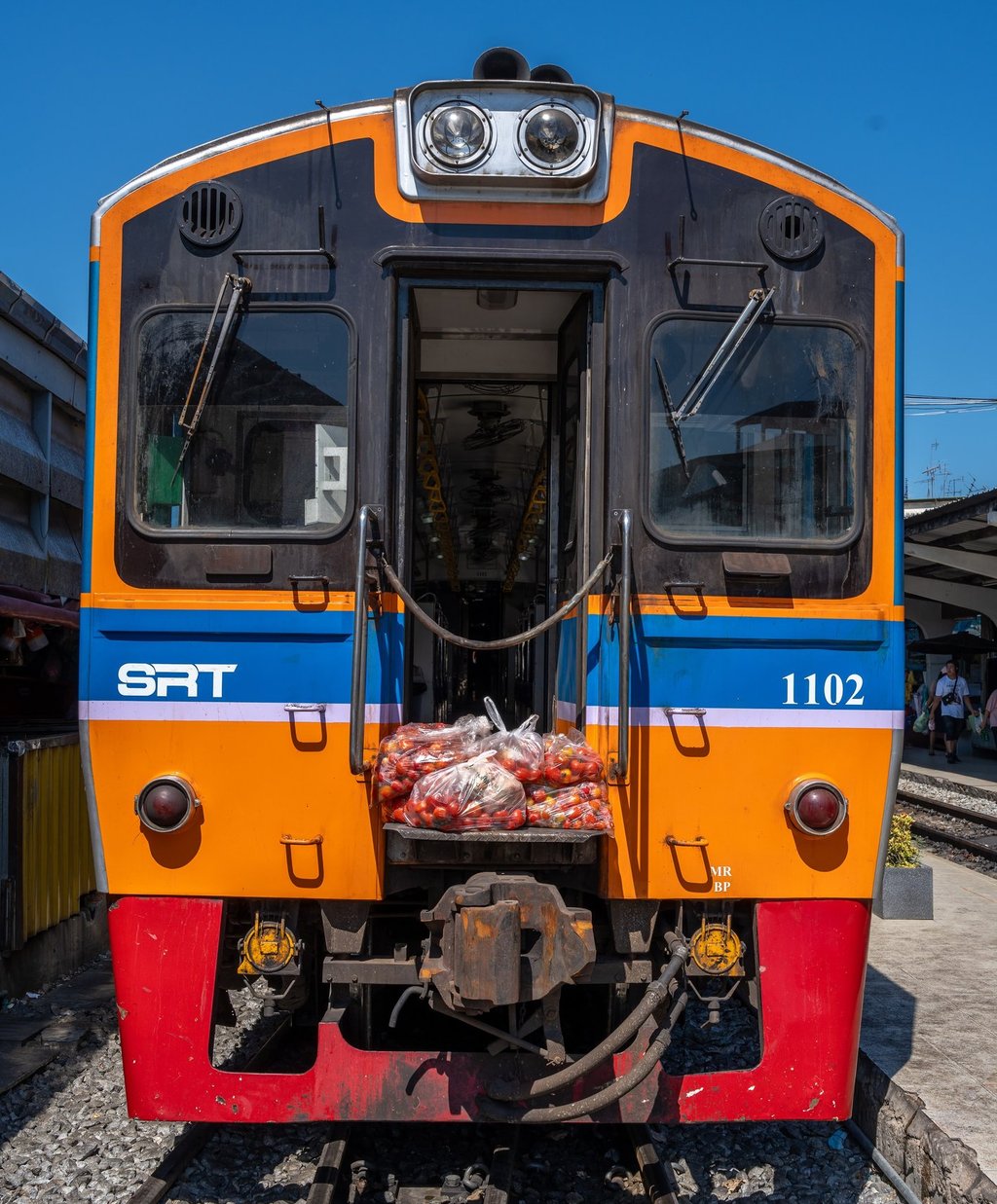
SRT locomotive 1102 stopped at a small station, orange and blue livery, front door wide open — and sitting on the front coupling, stacked neatly in plastic bags, a full delivery of fresh tomatoes. Red, ripe, going somewhere on a State Railway of Thailand train whether the timetable accounts for it or not.
We were standing on the platform when it happened. The driver had pulled in, someone came up with the tomatoes, a brief conversation took place, and the next thing we knew the bags were loaded onto the front of the locomotive and that was that. Departure in five minutes.
I've travelled by train across a lot of countries. I have never seen a locomotive used as a tomato delivery vehicle before.
This is Thailand. The rules are suggestions.
I stepped down onto the tracks — carefully — and shot dead centre, 35mm on the Sony Alpha 7 IV with the FE 24-70mm f/2.8 GM II. f/8 to keep the full face of the locomotive sharp from the coupling in the foreground to the open cab door behind. 1/250, hard midday sun, base ISO 100 — the orange paintwork needed the exposure kept tight to hold the colour without blowing out. The tomatoes and the SRT branding in the same frame — that's the shot. That's Thailand's railway system in one photograph.
The State Railway of Thailand runs routes that most tourists never take — small stations, local stops, third-class carriages, platform vendors selling food through the windows. It's slow, it's sometimes late, and it is absolutely worth doing if you want to see the country that exists between the airports and the beach resorts.
The Bangkok to Kanchanaburi line. The Northern Line up to Chiang Mai. The route down through Hua Hin to the south. All of them pass through stations like this one — small platforms, a handful of passengers, and apparently the occasional impromptu tomato delivery.
We watched the train pull out with the bags still sitting on the front coupling. Nobody on the platform found this unusual. We were the only ones with cameras out.
That's the thing about travelling in Thailand with a documentary mindset — the moments that stop you completely are always the ones nobody else is photographing.
Small station stop, State Railway of Thailand
Sony Alpha 7 IV · FE 24-70mm f/2.8 GM II · 35mm · f/8 · 1/250s · ISO 100
Family Lives on the Mekong. Their Home Has Tyres for Bumpers and Laundry Drying on the Deck, Southern Vietnam
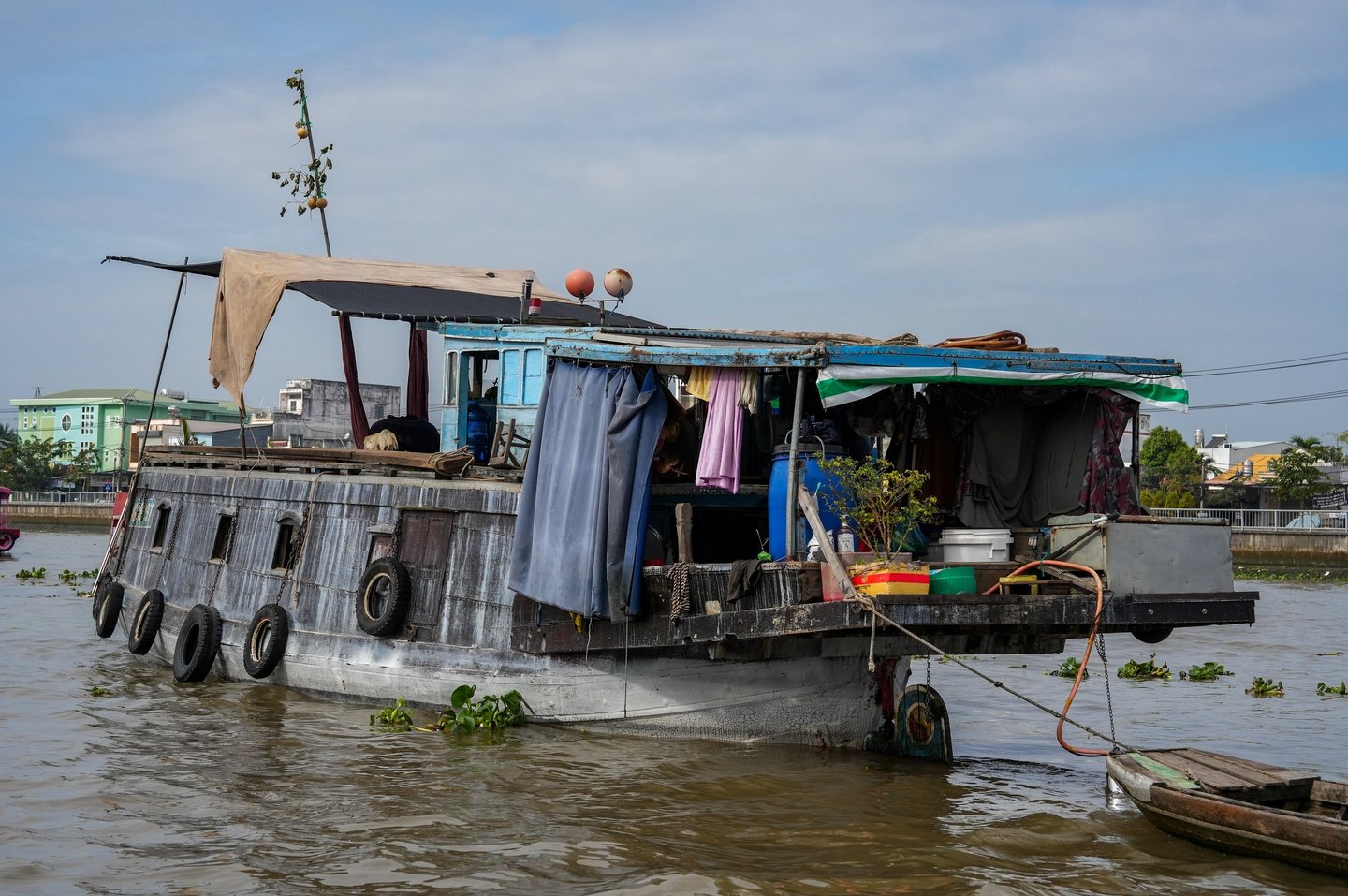
A weathered houseboat moored on the river near Cai Rang — blue-painted upper cabin, car tyres bolted along the hull as fenders, laundry hanging in the open section, a small potted plant on the deck, cooking equipment, plastic containers, a second small boat tied alongside. Everything a family needs, on a vessel that's also their home and their workplace.
We left Ho Chi Minh City at 4am. Two hours south by road, then onto the water at Can Tho. By the time the sun was properly up we were out on the Song Can Tho river in a small boat, threading through the traffic of the Cai Rang Floating Market — cargo barges, wooden fishing boats, vendors paddling between the larger vessels. And moored among all of it, houseboats like this one.
The families who live on these boats on the Mekong Delta have been doing so for generations. The river is the road, the market, the water supply, and the address. For many, moving onto land is not something they consider. The houseboat community along the branches of the Mekong represents a way of life that's been quietly disappearing as Vietnam modernises — younger generations moving to the cities, the floating villages gradually thinning out.
Our guide, our driver, and the captain of our boat all introduced themselves as South Vietnamese — not a political statement, just a matter-of-fact identification with the region and its history. A small detail that stays with you.
I shot this at 70mm on the Sony Alpha 7 IV with the FE 24-70mm f/2.8 GM II. f/8 to keep the full detail of the boat sharp from the hull tyres in the foreground to the cabin and the laundry at the back. 1/2500 — fast enough to freeze the movement of the boat on the water completely. ISO 1000 in the morning light coming off the river. The compression at 70mm pulls the background housing on the bank closer and frames the houseboat against the town behind it, which gives the shot its context — this is not wilderness, this is a community living on the water in the middle of a working river city.
The Cai Rang Floating Market runs from before dawn. Go early. The main trading is done by 8am and the market thins out quickly after that.
Cai Rang Floating Market, Can Tho, Mekong Delta, Vietnam
Sony Alpha 7 IV · FE 24-70mm f/2.8 GM II · 70mm · f/8 · 1/2500s · ISO 1000
Turn Left Off Bui Vien and This Is What Saigon Actually Looks Like, Vietnam
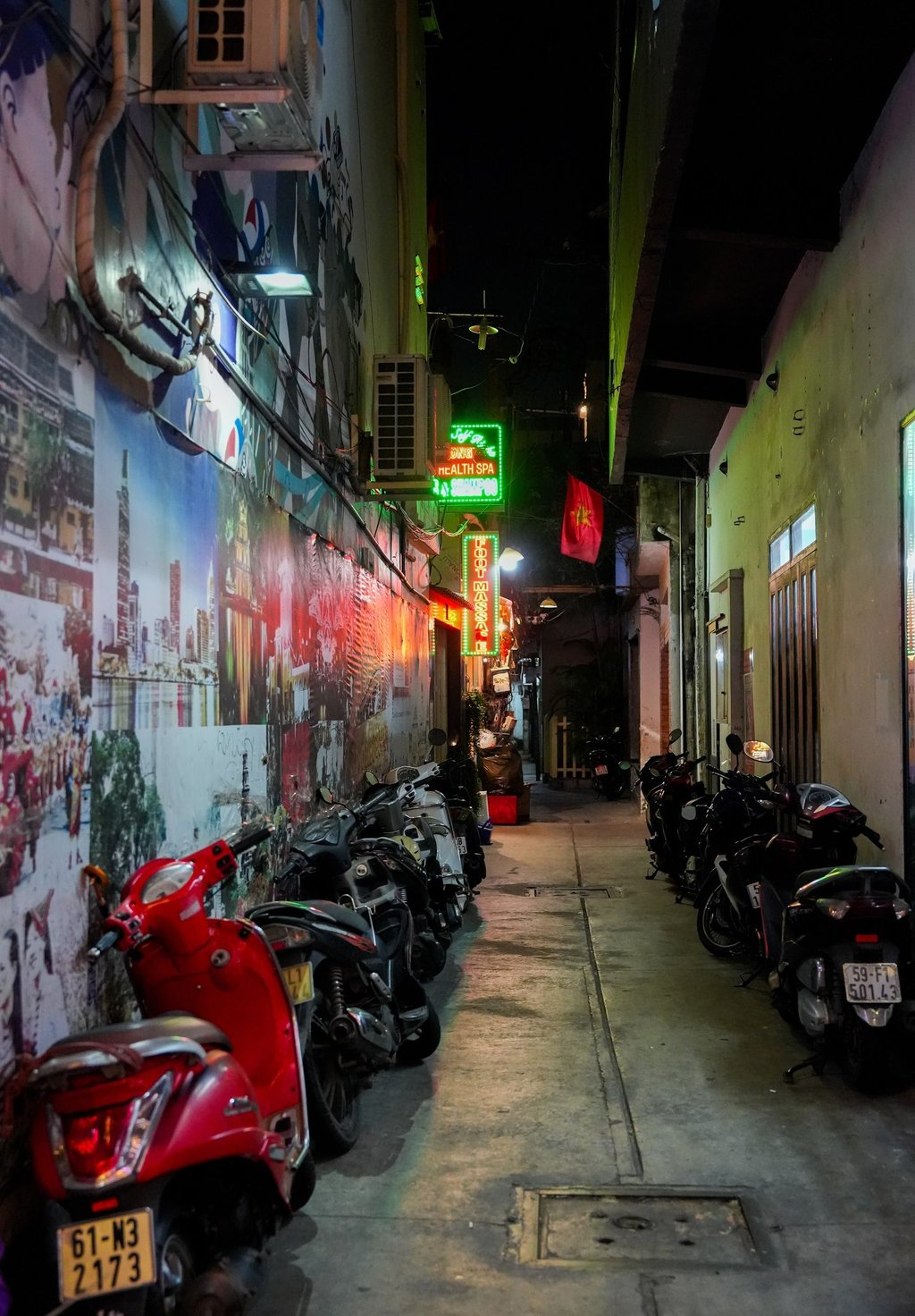
A narrow alley running parallel to Bui Vien Walking Street — motorbikes parked tight on both sides, a mural covering the full left wall, a green neon Health Spa sign glowing at the far end, a Vietnamese flag hanging above the passage, the alley narrowing down to maybe two metres wide. No tourists. No bar music. Just Saigon doing what it does when you step one street back from the obvious.
Bui Vien gets all the attention. The real character of District 1 lives in the alleys around it.
I shot this at 42mm on the Sony Alpha 7 IV with the FE 24-70mm f/2.8 GM II. f/3.5 to keep the full depth of the alley sharp from the red scooter in the foreground all the way to the neon signs at the far end. 1/250 to hold everything static cleanly. ISO 6400 — the available light in a Saigon back alley at night is a mix of neon, fluorescent spill and bare bulbs, all coming from different directions at different colour temperatures. The A7 IV at ISO 6400 handles the shadow detail in the right wall while keeping the neon signs from blowing out on the left. That balance is what the frame needed.
The mural on the left wall is the unexpected element. Street art covering an entire alley wall in the middle of the backpacker district — it sits between the parked scooters and the peeling plaster of the building opposite and somehow makes complete sense.
Ho Chi Minh City's District 1 is built around streets like Bui Vien and Pham Ngu Lao that everyone knows, and the grid of narrow alleys connecting them that almost nobody photographs. The alleys are where the city stores itself between the main roads — the parked bikes, the local businesses, the residents going in and out, the cats, the bins, the wiring hanging between buildings.
Photographically these passages are some of the most interesting spaces in Saigon. The compression of a narrow alley, the depth created by signs and light sources receding into the distance, the contrast between what's happening on the main street fifty metres away and the complete stillness in here — that's a frame that earns itself.
If you're shooting Saigon at night — walk the alleys. Leave Bui Vien and go one street in either direction. The city changes immediately.
Alley off Bui Vien Walking Street, District 1, Ho Chi Minh City, Vietnam
Sony Alpha 7 IV · FE 24-70mm f/2.8 GM II · 42mm · f/3.5 · 1/250s · ISO 6400
Two Naga Serpents, One Lake, and a Sunset That Had No Interest in Being Subtle
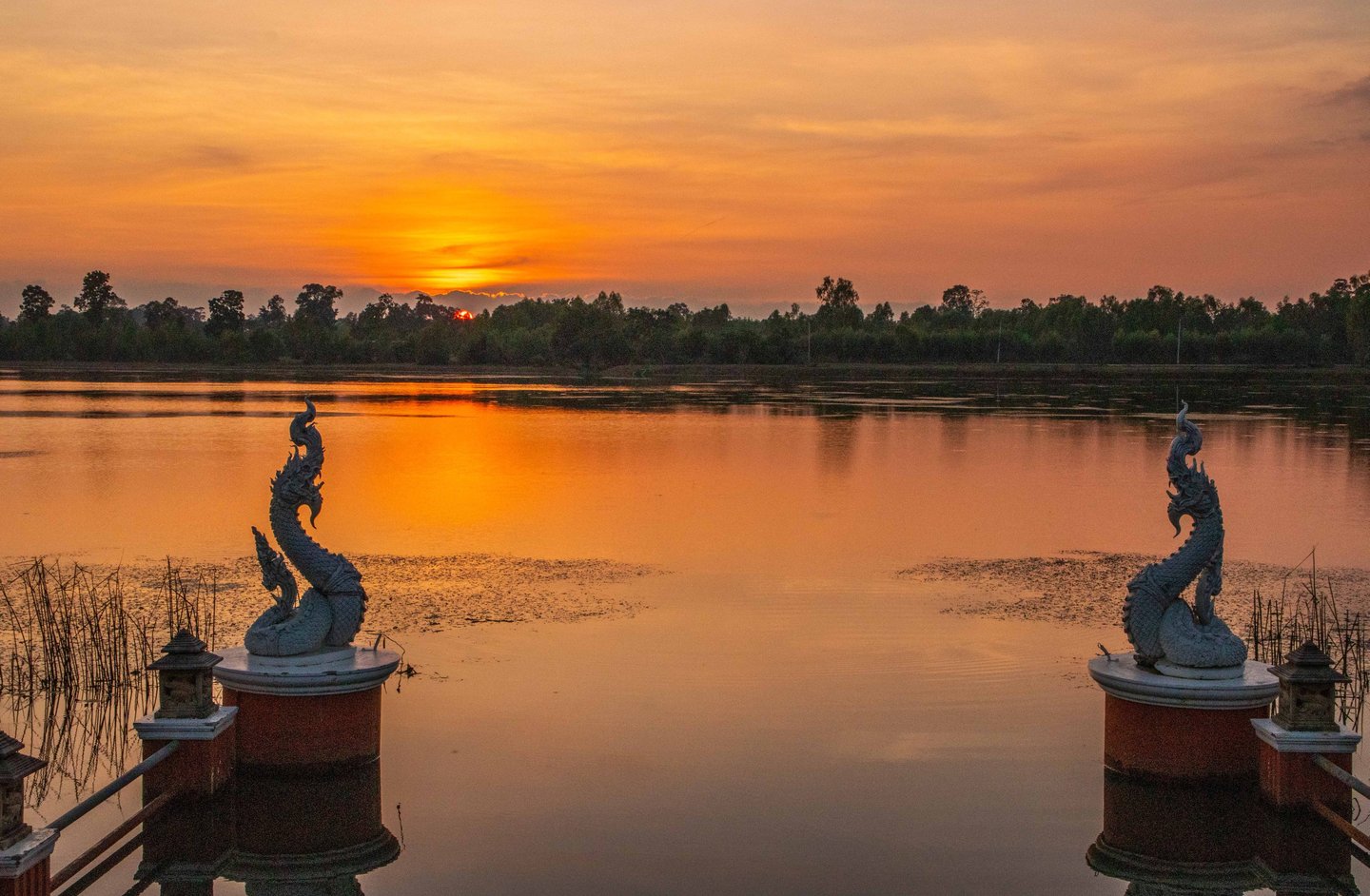
Two stone Naga serpent statues flanking the entrance to a lake pier, their silhouettes rising against a deep orange sky — the sun sitting just above the treeline on the far bank, the entire surface of the lake turning into a mirror of burnt orange and red. Ban Lalom, Sisaket Province, Northeast Thailand.
Nobody else was there. That's the thing about the Isaan.
I shot this at 50mm on the Sony Alpha 7 IV with the FE 24-70mm f/2.8 GM II. f/16 to keep everything sharp from the Naga statues in the immediate foreground to the treeline and the sun on the far horizon — full depth of field, nothing soft. 1/250 to hold the sun as a defined disc rather than a blown highlight. ISO 400, the last hard light of the day doing all the work.
The symmetry of the two statues framing the lake was already there. My job was just to find the right height to put the sunset between them.
Sisaket sits in the far east of the Isaan region, bordering Cambodia, and is one of the least visited provinces in Thailand. The Isaan — Thailand's northeast — covers roughly a third of the country's landmass and is home to the majority of Thailand's population, yet it barely registers on the standard tourist itinerary. Khmer-influenced temples, rice paddies, lakes and reservoirs, and a culture that feels distinct from both Bangkok and the north. The food is different, the dialect is different, the pace is different.
Most people driving through the Isaan are heading somewhere else. That's their loss.
Ban Lalom is a small community in Sisaket Province with no particular reason to appear on a travel itinerary. Which is exactly why the sunset over the lake looks like this — because nobody has turned it into an attraction yet.
Ban Lalom, Sisaket Province, Isaan, Thailand
Sony Alpha 7 IV · FE 24-70mm f/2.8 GM II · 50mm · f/16 · 1/250s · ISO 400
Hanoi Old Quarter — The Yellow Coffee House, a Hundred Motorbikes, and a City That Never Stands Still
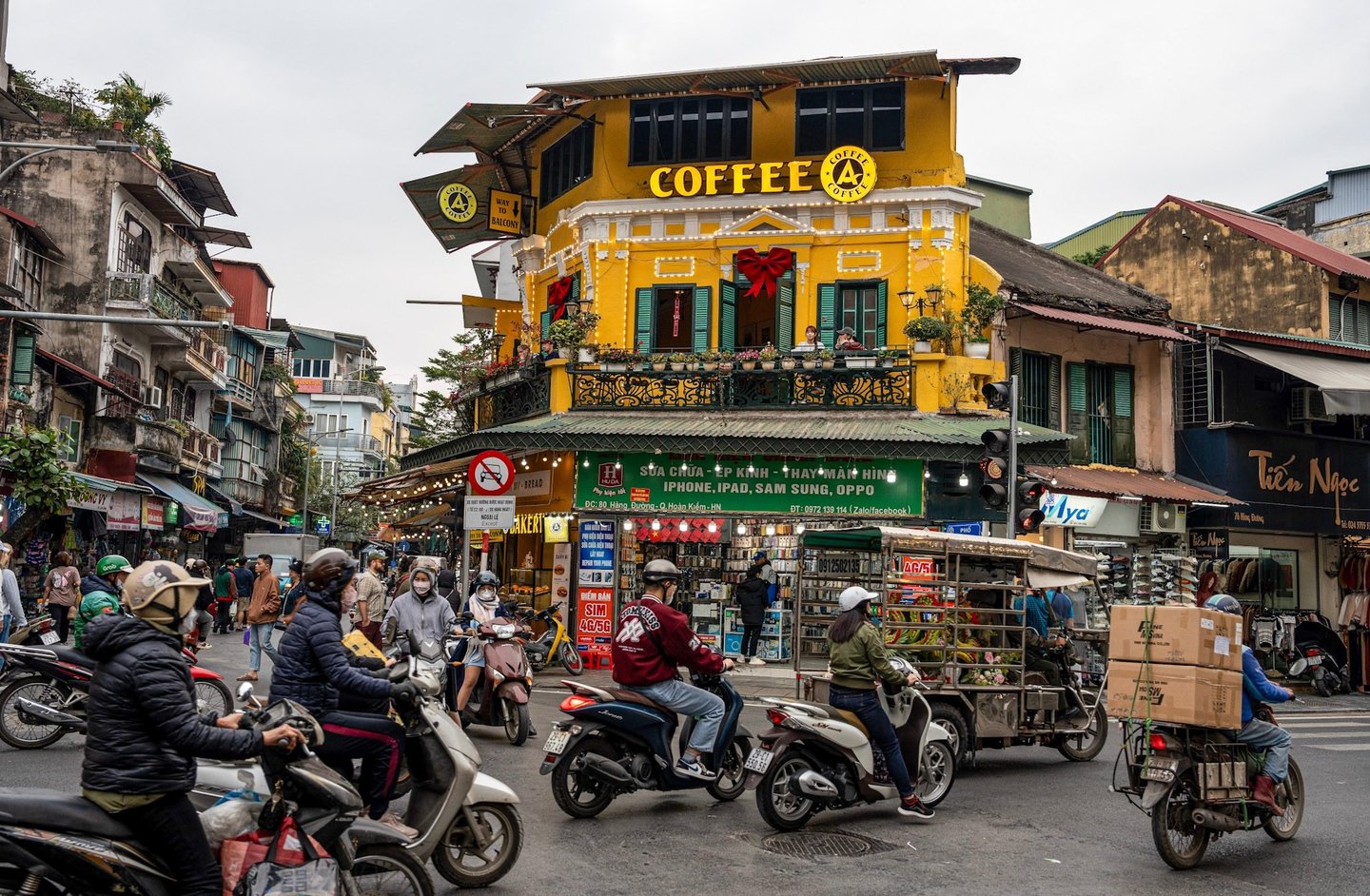
A bright yellow colonial-era building with green shutters and a balcony full of plants and diners — "Coffee A" across the top in bold lettering, fairy lights along the facade, red bows on the windows for the season. Below it, a Hanoi intersection running at full pace — motorbikes coming from every direction, a cargo bike loaded with cardboard boxes, a phone repair shop, a fruit stall, everyone threading through the junction without breaking stride.
This is Hang Duong Street in the Old Quarter, Hoan Kiem District. One of the most photographed corners in Hanoi — and still earning it every single day.
I shot this at 33mm on the Sony Alpha 7 IV with the FE 24-70mm f/2.8 GM II. f/5.6 to keep the full scene sharp from the motorbikes in the foreground to the coffee house facade and the buildings behind it. 1/320 to freeze the traffic cleanly — at this intersection nothing stops long enough for a slower shutter. ISO 640 under a flat overcast Hanoi winter sky, clean files, no noise problems.
33mm at this distance gave me the full width of the junction and the full height of the yellow building in one frame. Any tighter and you lose the street context. Any wider and the building loses its presence against the Old Quarter chaos around it.
Hanoi stays with you. The Old Quarter especially. Walking these streets feels less like a modern capital and more like something out of another century — faded ochre facades, wooden shutters, tiny cafés in shop-houses that have been there longer than anyone can remember. And then a hundred motorbikes come through the frame and remind you exactly where you are.
For street photography the Old Quarter is as good as it gets in Southeast Asia. Every corner is already a frame. You just have to be standing in the right spot when it lines up.
Hang Duong Street, Old Quarter, Hanoi, Vietnam
Sony Alpha 7 IV · FE 24-70mm f/2.8 GM II · 33mm · f/5.6 · 1/320s · ISO 640
Continue the journey →
Contact
Fuel my creativity, If you enjoy my content, feel free to support me with a small tip. Thanks for being part of this journey!
If you enjoy my photography and the stories I capture across Southeast Asia, consider supporting my journey. Every coffee helps me stay on the road longer and document more unique locations. Thank you for being part of the adventure!
Traveling across Southeast Asia, I’ve found that having an eSIM ready the moment you land is an absolute game-changer. I highly recommend Saily – I’ve had a great experience with them myself. It offers unbeatable advantages, especially for ordering a Grab taxi right away or using Google Maps to find your way as soon as you exit the airport
This post contains affiliate links for Saily. If you sign up through my link, I may earn a small commission at no extra cost to you. I only recommend services like Saily because I use them personally and they’ve made my travels much easier.
You can license my photography directly through my Alamy portfolio. My work covers authentic travel and street photography across Southeast Asia — Bangkok, Ho Chi Minh City, and the wider region — shot on location, not staged.
Looking for street scenes, urban editorial content, or landscapes from Thailand and Vietnam? My full collection is on Alamy, with licensing options from standard editorial to extended commercial rights, depending on what your project needs.
Disclosure: the link below is an affiliate link. If you license an image through it, I earn a share of the sale at no extra cost to you. It goes straight back into keeping me on the road and shooting across Southeast Asia.
© 2025 Strangphotography – Southeast Lens. All rights reserved.
All photos taken by me in public spaces. Licensing available via Alamy.
Unauthorized use prohibited. For full legal info, see my Imprint