Southeast Lens - Documentation, Travel and Street Photography

George Town, Penang (Malaysia) – Frame by Frame
Ever since Captain Francis Light landed here in 1786 and founded Britain's first trading post in Southeast Asia, George Town has grown into one of the region's most layered cultural crossroads. Weathered shophouse facades carry traces of British colonial rule, Chinese clan history, Indian migration, and Peranakan heritage side by side — sometimes on the very same street corner. In 2008, UNESCO recognized the historic inner city as a World Heritage Site, and walking through it still feels like moving through several centuries at once: the wooden stilt houses of the Clan Jetties, temples, mosques, and churches standing shoulder to shoulder.
Add to that a street art scene centered around Armenian Street, hawker stalls firing up at all hours, and that constant clash of harsh tropical sun and deep shadow, and George Town becomes one of the richest places in Southeast Asia to shoot street and travel photography.
On this page, I break George Town down picture by picture, Frame by Frame:
Image Description & Context — the story behind each frame, the people in it, and how the scene fits into everyday life in Penang.
Exact Location Details — precise spots across George Town's historic neighborhoods, useful if you're planning your own Penang trip.
Technical Breakdown — full transparency on camera gear, lens choice, settings (focal length, aperture, shutter speed, ISO), composition decisions, and the lighting conditions I was working with.
This page is built for photographers, Southeast Asia travelers, editors, and content creators who want a genuine, on-the-ground look at street photography in George Town, Penang, Malaysia — not a polished highlight reel, but the actual thinking behind each shot.
Red Roofs and One Tall Tower: George Town From Above
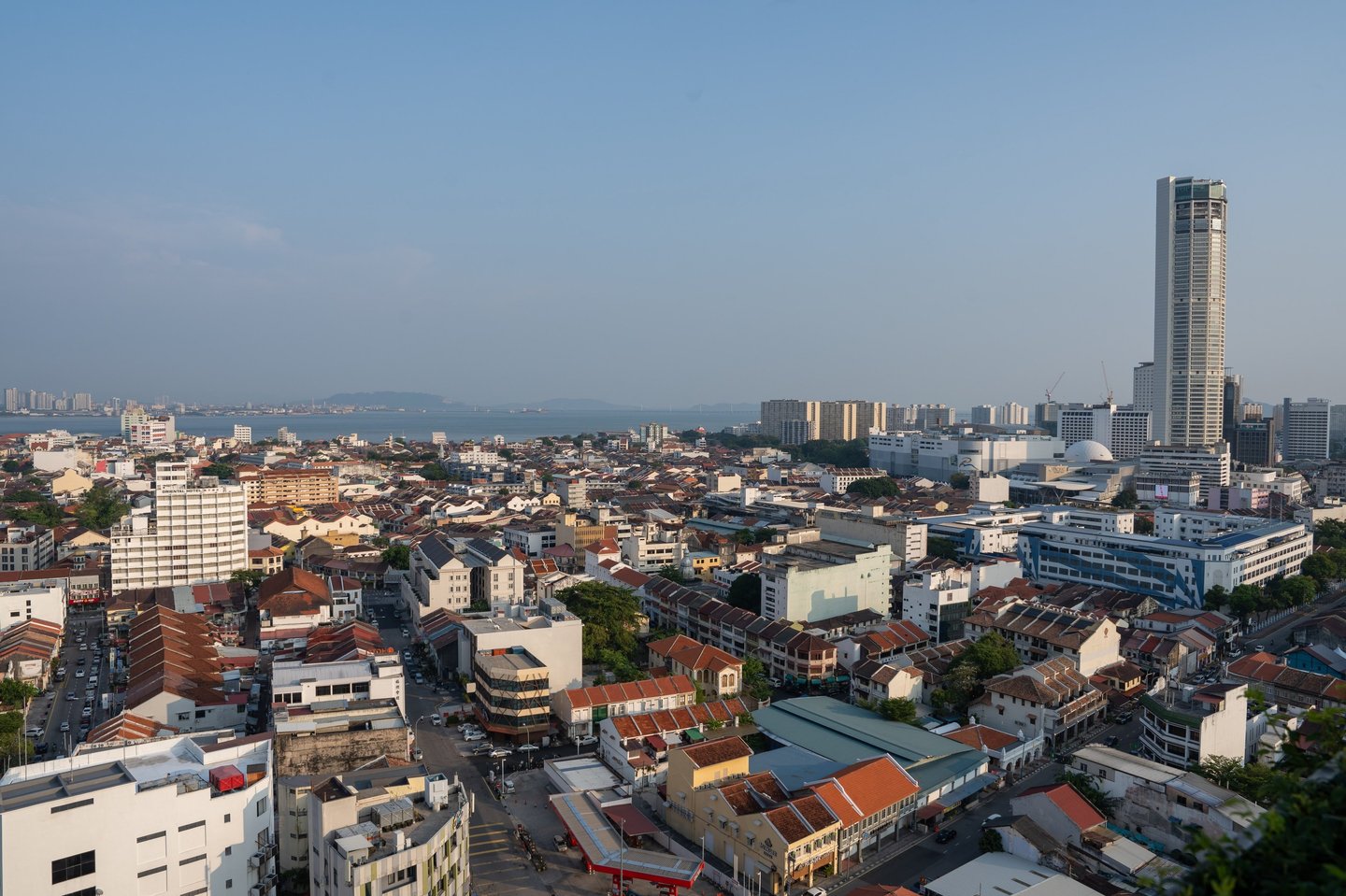
Hundreds of red-tiled shophouse roofs stretching to the sea, and one lone skyscraper standing over all of it like it wandered in from a different city.
This is George Town, Penang, Malaysia, shot from above in the early morning light. The historic UNESCO World Heritage core spreads out in the foreground — dense rows of colonial-era shophouses with their weathered clay-tiled roofs, narrow streets threading between them, the whole district looking almost unchanged from a century ago. Beyond it, Komtar Tower rises up out of the low-rise skyline, and further back, the Penang Strait and the hills of the mainland fade into the morning haze. This is the contrast that defines George Town: one of Southeast Asia's best-preserved colonial townscapes sitting directly beneath modern Penang's tallest building.
What pulled me toward this shot was the layering — history in the foreground, modern Penang stacking up behind it, and the sea closing the frame in the distance. You don't get this perspective walking the streets of George Town's old town; you need the elevation to actually see how the city is built in layers.
Here's why I set the camera the way I did. Clean morning light let me shoot at f/8 for real depth of field, holding both the rooftops in the foreground and Komtar Tower in the background sharp. 1/200 sec was more than enough for a completely static aerial scene. With strong available light, ISO 80 kept the file as clean as possible, zero compromise anywhere in the exposure. 24mm on the Sony FE 24-70mm f/2.8 GM II let me capture the full sweep of the old town rooftops, the tower, and the strait beyond in one wide frame.
Technical details:
Aerial view of George Town's historic UNESCO district and Komtar Tower, Penang, Malaysia. 1/200 sec, f/8.0, ISO 80, 24mm — Sony Alpha 7 IV with Sony FE 24-70mm f/2.8 GM II.
Fire, Gas Canisters, and a Line That Never Shrinks
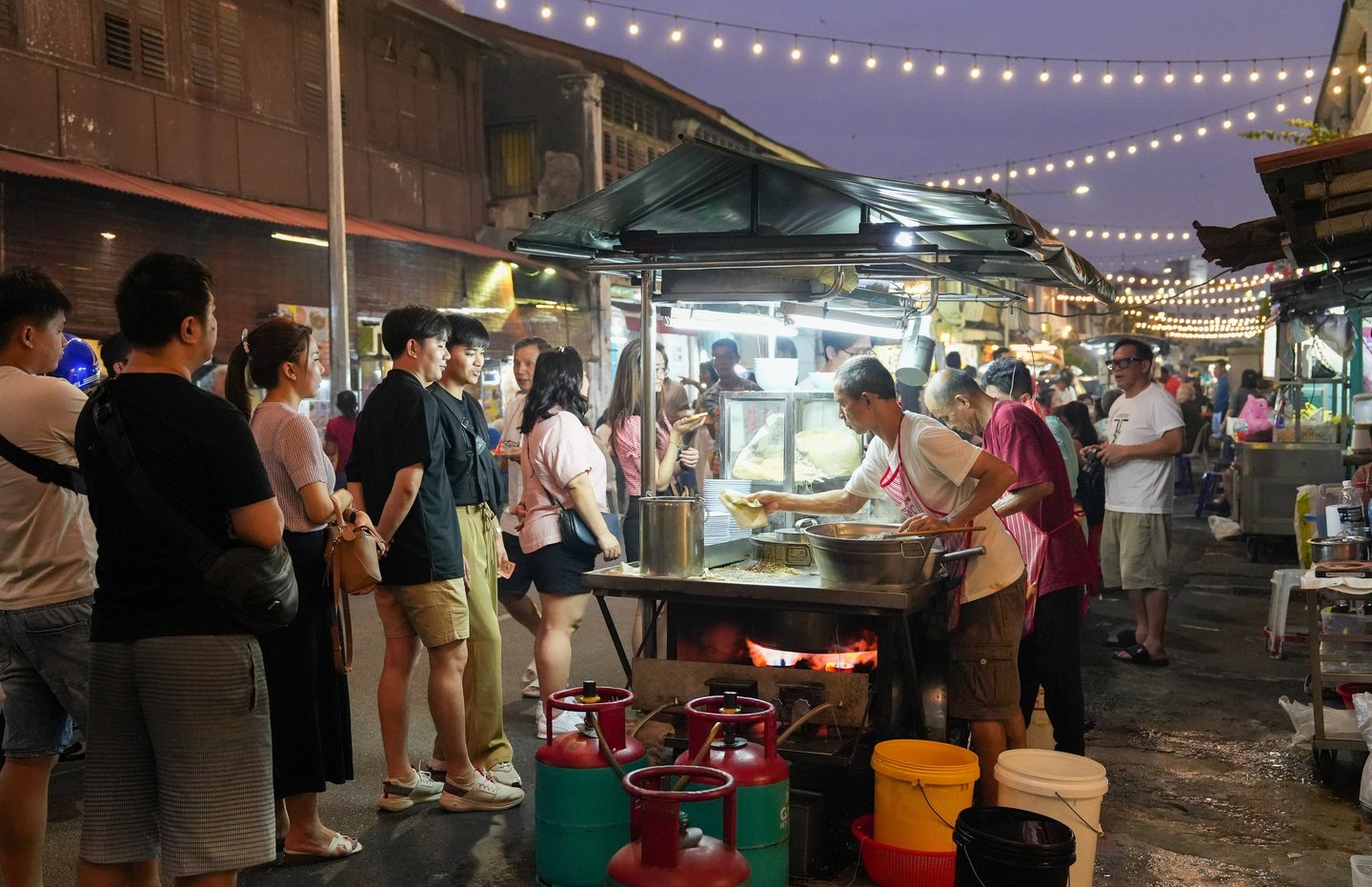
Flames roaring under a wok bigger than most home kitchens, gas canisters lined up like ammunition, and a queue that just keeps growing — this is street food in George Town, done the way it's been done for decades.
This is a hawker stall in George Town, Penang, Malaysia, photographed at dusk as string lights flicker on above the street. A vendor works fast under a metal awning, stirring a massive wok over open flame fed by red gas canisters, steam rising off the food while a line of locals and tourists waits patiently for their turn. This is one of the reasons George Town's street food scene has such a reputation across Southeast Asia — no menus, no seating apps, just a hawker stall, a fire, and a queue that tells you everything about whether the food is worth the wait.
George Town's hawker culture goes back generations, shaped by the same Chinese, Malay, Indian, and Peranakan influences that built the rest of this UNESCO-listed old town. Recipes like this one get passed down inside families, cooked on the same stretch of street year after year, and the crowd shows up regardless of whether there's a sign out front or not. Half the appeal is exactly this — no polish, no branding, just a stall that's earned its reputation through decades of word of mouth.
What I love about photographing this scene is the layering of activity — cooking, waiting, chatting, all happening under one small awning while the rest of the street keeps moving in the background, colonial-era shophouses fading into the dusk sky behind it all. Scenes like this are why George Town keeps pulling in street and travel photographers from all over Southeast Asia; there's always another layer once you slow down and actually watch how a stall like this runs.
Here's why I set the camera the way I did. Dusk light with mixed sources — string lights, the stall's own fluorescent tube, the fire itself — meant working with real contrast across the frame. f/3.5 gathered enough of that light while still holding good depth of field across the queue and the stall. 1/200 sec froze the vendor's hands mid-motion without any hesitation. That combination pushed ISO to 5000, necessary to pull a clean exposure at dusk with this much going on. 36mm on the Sony FE 24-70mm f/2.8 GM II held the full stall, the fire, and the waiting crowd in one frame.
Part of my ongoing series on George Town and Southeast Asia street photography.
Technical details:
A hawker food stall, George Town, Penang, Malaysia. 1/200 sec, f/3.5, ISO 5000, 36mm — Sony Alpha 7 IV with Sony FE 24-70mm f/2.8 GM II.
Wooden Planks, Open Water: The Quiet End of Tan Jetty
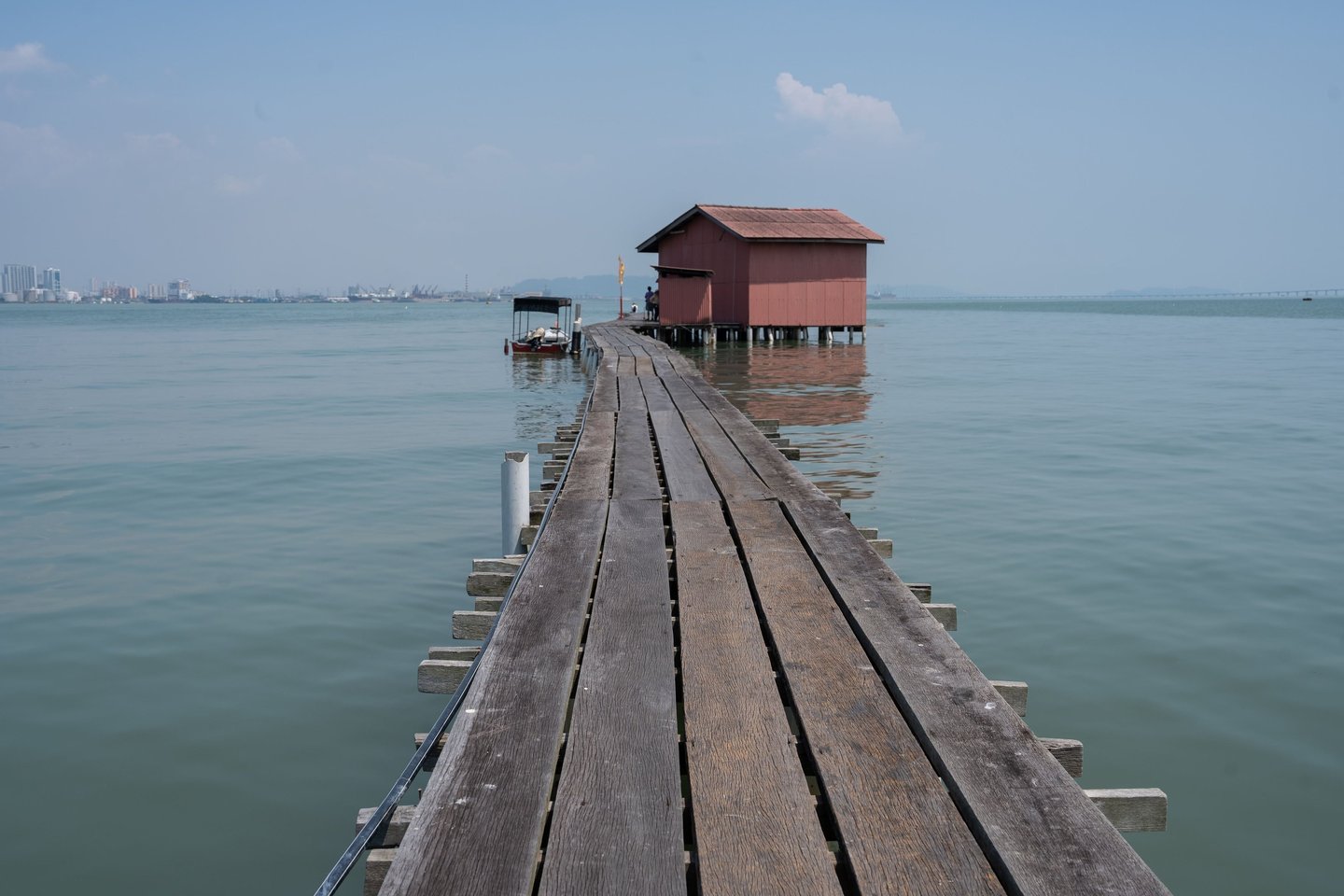
A weathered wooden walkway stretching straight out over calm water, a small red house on stilts waiting at the end of it — some places don't need people in the frame to tell a story.
This is Tan Jetty in George Town, Penang, Malaysia, one of the historic stilt villages built out over the water and part of the city's UNESCO-listed heritage. Unlike the busier Chew Jetty just down the shoreline, which pulls in most of the tourist crowds, Tan Jetty tends to stay quiet — a handful of houses on wooden pillars, a small boat moored near the walkway, and long stretches where you can hear nothing but water lapping against the stilts underneath you. These clan jetties were built by early Chinese immigrant families arriving in Penang, each jetty settled and still largely occupied by a single clan, a piece of living history that's stayed inhabited for well over a century.
What pulled me toward this shot was the walkway itself — the way the worn wooden planks lead the eye straight out to that single red building at the far end, with George Town's modern skyline sitting hazy in the distance on the left, a quiet contrast between old and new Penang in one frame.
Here's why I set the camera the way I did. Bright daylight let me close down to f/8 for real depth of field, holding the wooden planks sharp from close range all the way out to the house at the end of the jetty. 1/320 sec was more than enough for a completely static scene. With strong available light, ISO 100 kept the file clean with zero compromise anywhere in the exposure. 35mm on the Sony FE 24-70mm f/2.8 GM II gave a natural perspective that let the jetty's converging lines lead straight through the frame without distortion.
Part of my ongoing series on George Town and Southeast Asia travel photography.
Technical details:
Tan Jetty, George Town, Penang, Malaysia. 1/320 sec, f/8.0, ISO 100, 35mm — Sony Alpha 7 IV with Sony FE 24-70mm f/2.8 GM II.
Red Lanterns Over Love Lane: George Town After Dark
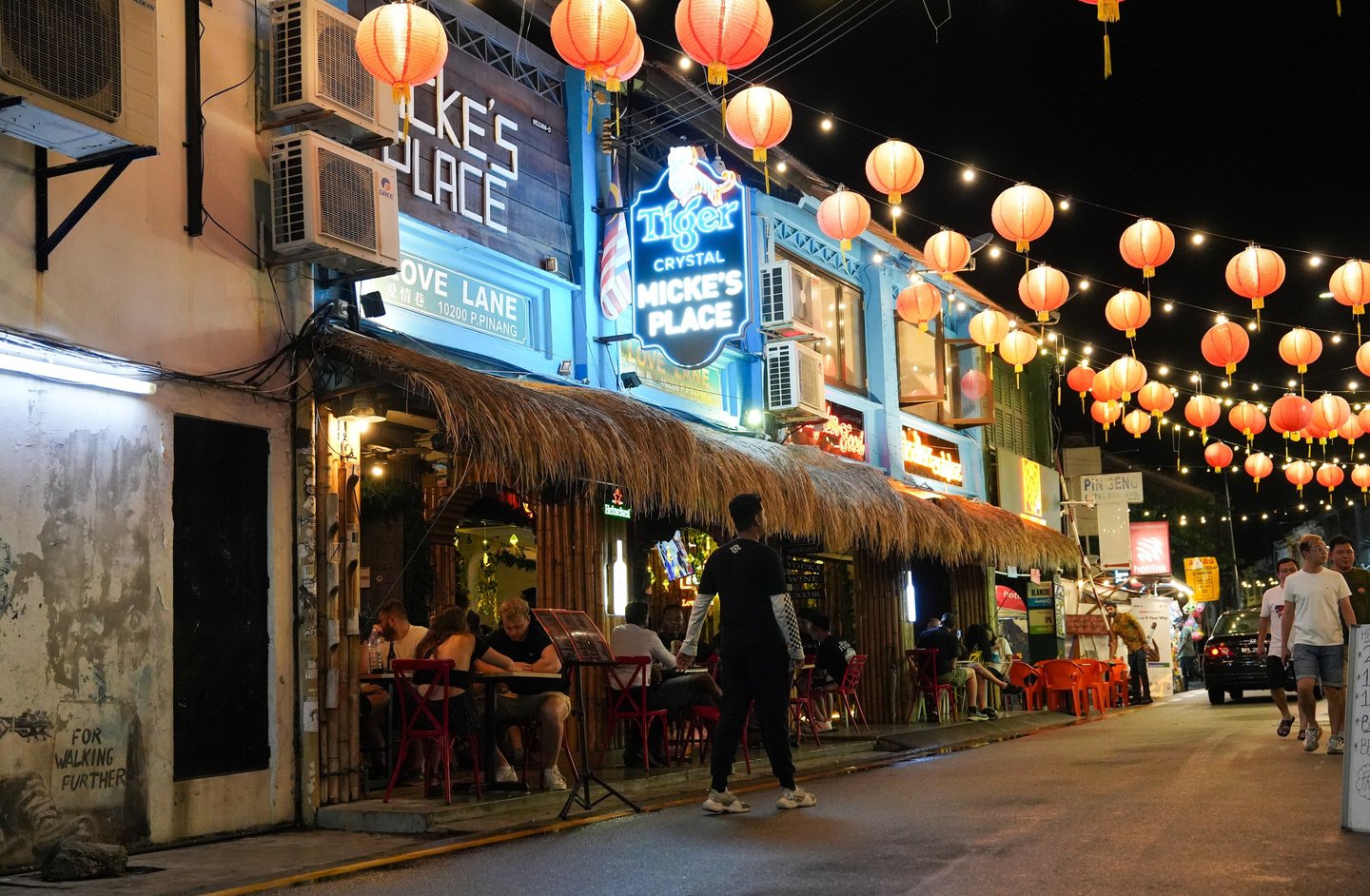
Rows of glowing red lanterns stretched across the street, a thatched bamboo bar underneath, and Love Lane doing exactly what it's known for after sunset.
This is Love Lane in George Town, Penang, Malaysia, one of the city's most photographed nightlife streets, lit up with strings of Chinese lanterns hanging between the shophouses. Below them, bars and restaurants spill out onto the sidewalk — bamboo-thatched awnings, neon beer signage, red plastic chairs filled with a mix of locals and travelers. A man walks down the middle of the street past graffiti reading "for walking further," a black car idles further back, and the whole scene glows in warm lantern light against the pitch-black night sky. Love Lane has carried that name since colonial times, when the street reportedly got its reputation as a place where wealthy men kept their mistresses close to the main house — today it's simply George Town's go-to strip for bars, live music, and street-level nightlife.
What pulled me toward this shot was the sheer volume of lanterns overhead, stacked in rows disappearing into the dark, with just enough foreground activity — the walking figure, the lit-up bar — to hold the eye before it drifts up into all that red.
Here's why I set the camera the way I did. Night streets lit almost entirely by lantern glow and neon signage meant working with limited, uneven light. f/3.2 pulled in enough of that light while still holding reasonable depth across the street. 1/250 sec was fast enough to freeze the walking figure completely without a second thought. That combination still demanded ISO 5000 to get a clean, usable exposure out of a scene with this much contrast between bright lanterns and dark sky. 40mm on the Sony FE 24-70mm f/2.8 GM II let me hold the full string of lanterns overhead along with the street life below in one frame.
Technical details:
Love Lane, George Town, Penang, Malaysia. 1/250 sec, f/3.2, ISO 5000, 40mm — Sony Alpha 7 IV with Sony FE 24-70mm f/2.8 GM II.
Kids on a Bicycle: George Town's Most Photographed Wall


A real, rusted-out bicycle leaning against a mural of two kids mid-joyride — no other piece of street art in Malaysia gets photographed more than this one.
This is "Little Children on a Bicycle," the most famous mural in George Town, Penang, painted by Lithuanian artist Ernest Zacharevic in 2012 for the George Town Festival, on the wall of a shophouse where Lebuh Armenian meets Gat Lebuh Armenian. The mural shows a young girl giving her little brother a ride, both faces caught somewhere between joy and pure panic, and Zacharevic paired the painting with an actual bicycle mounted against the wall so the whole scene reads as one mixed-media piece rather than flat paint on concrete. The kids in the mural weren't models — they were photographed doing sketching work with Urban Sketchers Penang near the Goddess of Mercy Temple, and Zacharevic turned that reference photo into what's become Malaysia's unofficial street art icon. It's been reproduced on tote bags, magnets, keychains, even an AirAsia plane livery without the artist's permission, and Zacharevic restored the original mural himself in 2024 to keep it looking the way it did the day he first painted it.
What pulled me toward this shot wasn't just the mural itself, but how weathered the wall around it has become — cracked plaster, patchy paint, decades of humidity — while the bicycle and the painted kids stay frozen in that same moment of motion.
Here's why I set the camera the way I did. f/7.1 gave enough depth of field to hold both the bicycle in the foreground and the mural behind it completely sharp — with the two elements sitting at slightly different distances, I needed that margin. 1/250 sec was more than enough for a static scene. Clean daylight let ISO 80 keep the file spotless, no compromise anywhere in the exposure. 60mm on the Sony FE 24-70mm f/2.8 GM II compressed the bicycle against the wall just enough to make the mixed-media illusion read clearly in the frame.
Technical details:
"Little Children on a Bicycle" mural by Ernest Zacharevic, Armenian Street, George Town, Penang, Malaysia. 1/250 sec, f/7.1, ISO 80, 60mm — Sony Alpha 7 IV with Sony FE 24-70mm f/2.8 GM II
The Whole Old Town in One Frame: George Town From the Sky


Thousands of red-tiled rooftops packed edge to edge, cargo ships lined up in the strait behind them, and one clock tower marking the spot where the old world meets the working port.
This is George Town, Penang, Malaysia, shot straight down from above, showing the full sweep of the UNESCO World Heritage core as it meets the Penang Strait. Row after row of colonial-era shophouses fill the frame, their weathered clay-tiled roofs stacked in a dense grid, narrow streets cutting between them at odd angles that trace back to the city's original 18th-century layout. Along the waterfront, a cluster of colonial landmarks stands out — the clock tower, ferry terminal, and heritage buildings clustered near the jetty — while further out in the strait, container ships and gantry cranes work the port, mainland Penang fading into the haze on the far shore. This single frame captures both sides of George Town at once: the preserved, centuries-old townscape and the modern shipping lanes that still keep this island connected to the world.
What pulled me toward this shot was the sheer density from above — nothing about George Town's old town reads as sparse or spread out, it's roof after roof after roof, all the way to the water's edge, with barely a gap in between.
Here's why I set the camera the way I did. Clean daylight let me shoot at f/8 for real depth of field, holding both the rooftops closest to the lens and the port activity far in the background sharp. 1/200 sec was more than enough for a completely static aerial scene. With strong available light, ISO 50 kept the file as clean as possible, zero compromise anywhere in the exposure. 34mm on the Sony FE 24-70mm f/2.8 GM II let me capture the full width of the old town along with the strait and mainland beyond it in one wide frame.
Part of my ongoing series on George Town and Southeast Asia travel photography.
Technical details:
Aerial view of George Town's historic UNESCO district and the Penang Strait, Penang, Malaysia. 1/200 sec, f/8.0, ISO 50, 34mm — Sony Alpha 7 IV with Sony FE 24-70mm f/2.8 GM II
I Want Bao! The Mural That Turned a Pastry Shop Into a Photo Stop


Two kids reaching through painted window bars, one climbing on the other's shoulders just to get closer to the buns outside — this shophouse wall sells more pastries than any sign ever could.
This is "I Want Bao!" (also called "I Want Pau!"), a mural by Penang-based artist WK Setor on Gat Lebuh Armenian in George Town, painted for the Ming Xiang Tai Pastry Shop right next to it. The two children in the painting reach desperately through a barred window toward a bicycle loaded with steamed buns parked just outside — a clever piece of commercial street art that turned a simple shop advertisement into one of George Town's most photographed murals. In this frame, the red New Year decorations and dried palm leaves hanging above the doorway add a seasonal layer on top of the artwork, while the shophouse's original wooden shutters and a "no smoking" sign sit right beside it, half heritage building, half open-air gallery.
What I like about this piece is how unapologetically commercial it is and how well it still works as art — most murals in George Town exist purely for tourists to photograph, but this one has an actual business behind it, and the mural still holds up completely on its own.
Here's why I set the camera the way I did. Shooting close to a textured wall in mixed shade and reflected light meant working carefully with contrast. f/7.1 gave enough depth of field to hold both the mural in the foreground and the shopfront details beside it sharp. 1/15 sec was slow enough to properly expose the shaded scene without a flash, held steady to avoid any blur. ISO 80 kept the file completely clean given the available light. 40mm on the Sony FE 24-70mm f/2.8 GM II let me frame the full mural along with the surrounding shopfront detail in one tight, readable shot.
Part of my ongoing series on George Town and Southeast Asia street art photography.
Technical details:
"I Want Bao!" mural by WK Setor, Gat Lebuh Armenian, George Town, Penang, Malaysia. 1/15 sec, f/7.1, ISO 80, 40mm — Sony Alpha 7 IV with Sony FE 24-70mm f/2.8 GM II.
Built in 1897, Reborn on Stilts: Church Street Pier


Two orange-roofed pavilions standing on concrete pillars straight out of the Penang Strait, connected by a long covered walkway — this pier has watched over a hundred years of ships come and go.
This is Church Street Pier in George Town, Penang, Malaysia, built in 1897 as one of the docking points along George Town's eastern coastline during the height of the Port of Penang's trading power, when the strait rivaled Singapore for maritime traffic — records from 1879 show over a thousand vessels passing through in a single 24-hour period. Ferries to Butterworth once ran from here before the crossing moved further south, and as the port declined through the late 20th century, Church Street Pier fell into disuse and slow decay. In the early 2000s, the Malaysian government took on a project to restore it, and today the twin pavilions with their tiled orange roofs stand rebuilt over calm turquoise water, container cranes from the working port still visible in the distance on the left.
What pulled me toward this shot was the layering of eras — a century-old pier, a modern working port in the background, and Penang's mainland skyline barely visible on the horizon, all sitting in one frame of restored colonial architecture over open water.
Here's why I set the camera the way I did. f/9 gave enough depth of field to keep both pavilions sharp from the closer structure all the way to the one further down the walkway. 1/320 sec was more than enough for a completely static architectural scene. With strong daylight, ISO 100 kept the file clean, zero compromise anywhere in the exposure. 32mm on the Sony FE 24-70mm f/2.8 GM II let me hold both pavilions and the connecting walkway in one wide, balanced frame.
Technical details:
Church Street Pier, George Town, Penang, Malaysia. 1/320 sec, f/9.0, ISO 100, 32mm — Sony Alpha 7 IV with Sony FE 24-70mm f/2.8 GM II.
Yellow Shophouse, Green Grab Bike: A George Town Corner After Dark


A curved yellow shophouse corner, red ribbon still hanging over a fresh dessert shop opening, and a Grab delivery bike parked out front waiting for the next order — this is George Town after the tourists thin out.
This is a street corner in George Town, Penang, Malaysia, photographed at night, showing the layered signage that defines this city's shopfronts — "Wan Bao Fu," a wholesale fruit shop, faded traditional Chinese lettering reading "Nam Hong Chiew Hong" above a newer dessert shop lit in purple neon, string lights strung along the building's curved facade. Blue plastic stools sit empty outside, a motorbike rider pauses on the street corner, and a green Grab delivery bike waits parked near the entrance — that familiar green a fixture of nearly every street corner across Southeast Asia these days. This is George Town at the exact moment where old shophouse trade — dried goods, wholesale fruit, decades-old restaurant signage — sits directly beside app-based delivery culture, both operating out of the same century-old building.
What pulled me toward this shot was that contrast between eras stacked into one frame — faded painted signage from a much older business right above a brand-new neon storefront, with a Grab bike parked underneath both of them like it's always belonged there.
Here's why I set the camera the way I did. Night streets like this run on mixed lighting — string lights, neon signage, streetlights — so I opened to f/3.2 to gather enough of that light while still holding reasonable depth of field across the building's curved facade. 1/200 sec was fast enough to freeze the motorbike rider without a second thought. That combination pushed ISO to 5000, necessary given the contrast between the lit shopfronts and the pitch-black sky above. 24mm on the Sony FE 24-70mm f/2.8 GM II let me capture the full curve of the building along with the street activity below it in one wide frame.
Part of my ongoing series on George Town and Southeast Asia street photography.
Technical details:
A shophouse corner, George Town, Penang, Malaysia. 1/200 sec, f/3.2, ISO 5000, 24mm — Sony Alpha 7 IV with Sony FE 24-70mm f/2.8 GM II
The Indian Boatman: George Town's Quietest Mural


An old man in a checkered sarong, one hand gripping a wooden oar that stretches clean across the entire wall, painted so realistically he looks ready to step off the plaster.
This is "The Indian Boatman," a mural by Russian street artist Julia Volchkova on Klang Street in George Town, Penang, Malaysia, painted in 2014 on the corner of a building facing Stewart Lane. Volchkova spent ten days completing this piece as a tribute to the Indian community's role in George Town's maritime history — this stretch of the old town, once called Boatmen's Alley, was home to Indian and Hainanese sailors who worked the harbor for generations. The mural was created entirely from a photograph, painted freehand with no guiding sketch, and it shows: the man's expression, the folds of his shirt, the weathered turmeric-orange turban all carry a photographic realism that's rare in street art. Look closely at the oar and you'll notice it starts out wooden near his hand and gradually shifts to metallic further along the wall — a small detail most visitors walk straight past.
What pulled me toward this shot was the crumbling brick exposed at the base of the wall, the paint peeling away exactly where the boatman's feet meet the ground — as if the mural itself is slowly returning to the building it's painted on.
Here's why I set the camera the way I did. f/6.3 gave enough depth of field to hold the full height of the mural sharp, from the window above to the exposed brick below. 1/125 sec was more than enough for a static wall. Strong daylight kept ISO 50 completely clean, no compromise anywhere in the exposure. 24mm on the Sony FE 24-70mm f/2.8 GM II let me capture the mural's full scale in one vertical frame without stepping back across the narrow street.
Part of my ongoing series on George Town and Southeast Asia street art photography.
Technical details:
"The Indian Boatman" mural by Julia Volchkova, Klang Street, George Town, Penang, Malaysia. 1/125 sec, f/6.3, ISO 50, 24mm — Sony Alpha 7 IV with Sony FE 24-70mm f/2.8 GM II.
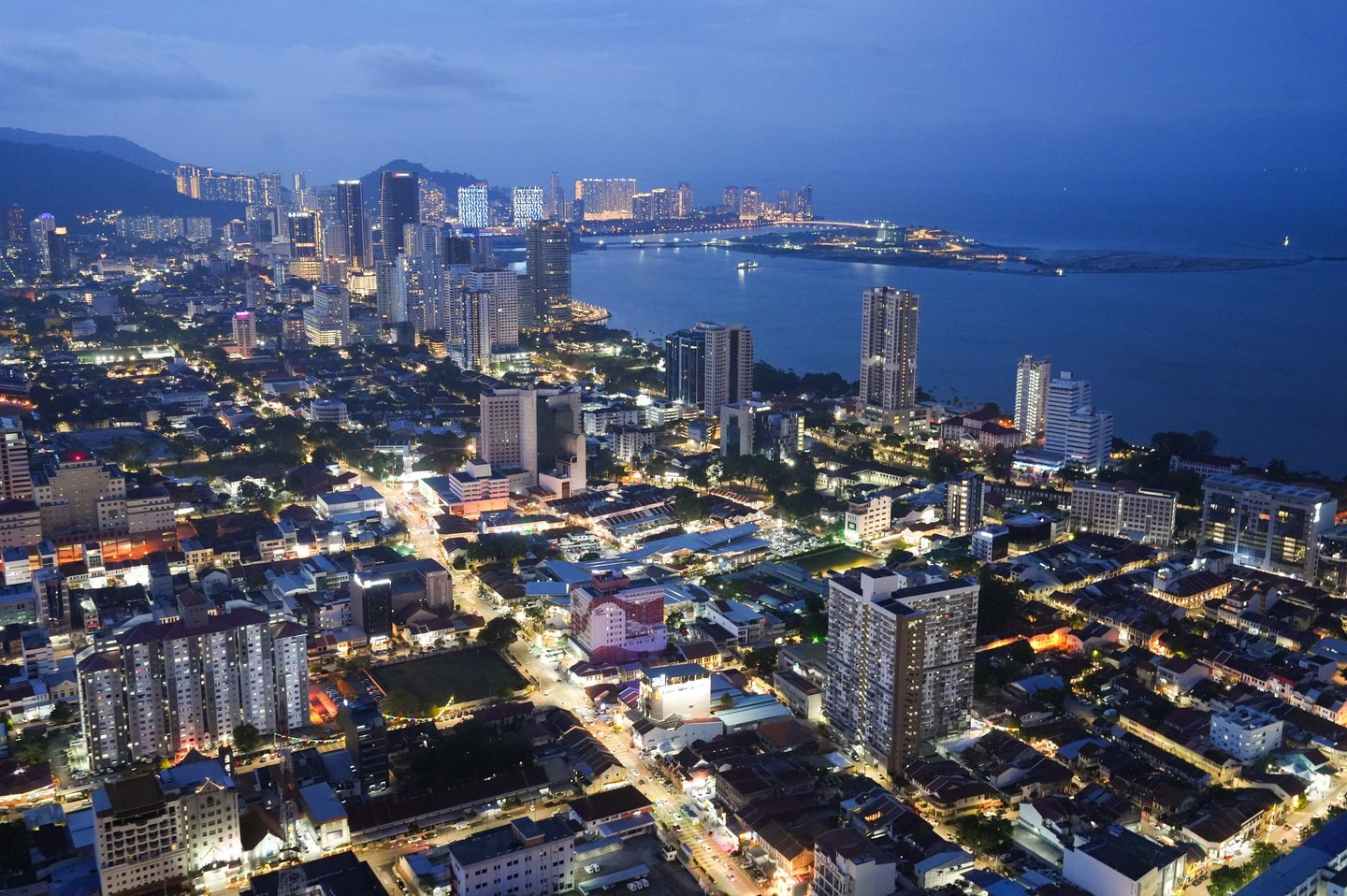
George Town at Night: The Whole Coastline Lit Up From Above


Thousands of lit windows stretching along the coast, the Penang Bridge glowing faintly in the distance, and George Town's entire nighttime skyline caught in one long exposure.
This is George Town, Penang, Malaysia, shot from above at night, showing the city's coastline curving out toward the Penang Bridge on the horizon. High-rise condos and hotel towers dominate the middle distance, their windows lit gold and white, while the older, low-rise shophouse grid of the historic UNESCO district fills the foreground, dark rooftops and narrow street grids barely visible against the brighter towers behind them. Streetlights trace the road network in warm amber lines, cutting through the dense urban layout below. This single frame captures both versions of George Town at once — the compact colonial-era old town and the vertical, modern skyline that's grown up around it over the last few decades.
What pulled me toward this shot was the contrast in density — tight, dark rooftops up close giving way to towering, brightly lit condos further back, with the sea and the bridge fading into near-total darkness at the very edge of the frame.
Here's why I set the camera the way I did. Night aerial shots like this mean working with almost no usable natural light, so I opened to f/5.6 to gather enough of the city's own lighting while still holding reasonable depth of field across the frame. At 1/6 sec I needed a completely stable position — no handheld shot survives that shutter speed without blur — which let me properly expose the scene without pushing ISO into an unusable range. Even then, ISO 4000 was necessary to pull a clean, detailed exposure out of a scene this dark beyond the city lights themselves. 33mm on the Sony FE 24-70mm f/2.8 GM II let me capture the full sweep of the coastline from the old town to the bridge in one wide frame.
Part of my ongoing series on George Town and Southeast Asia travel photography.
Technical details:
Aerial night view of George Town and the Penang Bridge, Penang, Malaysia. 1/6 sec, f/5.6, ISO 4000, 33mm — Sony Alpha 7 IV with Sony FE 24-70mm f/2.8 GM II
RED, READY, AND REAL - The Hidden Fire Power of Georgetown


You walk past a tiny garage in Georgetown and BAM - two monsters in red staring at you. No museum. No show. Pure working reality.
Georgetown, Penang is street photography heaven. Not because of the wall art everyone hunts. Because of moments like this. Inside the Bomba Sukarela Sri Tanjung station - the volunteer fire brigade.
What you see: Two classic fire trucks parked shoulder to shoulder. Front: HINO PQM 845 with Bomba Sri Tanjung on the windscreen and 喬治市義務消防隊 - Georgetown Volunteer Fire Brigade - in bold yellow Chinese characters. Behind it: Nissan Diesel PJR 8837. Chrome, dust, reflections, portraits on the wall, red plastic chairs. This is community. In Malaysia like in Myanmar, these volunteer stations are the backbone of the neighborhood. They don't wait for permission. They act.
Why I took it like this: I'm a traveler and photographer in Southeast Asia for years. From Myanmar to Malaysia, the real stories are behind open doors. I wanted to be close. Respectful, but close. To feel the size.
My tool: Sony Alpha 7 IV + Sony FE 24-70mm f/2.8 GM II. My go-to for street photography Penang and travel photography Southeast Asia.
The settings - and why:
At 24mm I get the whole story. The low angle, the chrome bumper, the two trucks leading deep into the station. Wide angle creates power.
f/8.0 - street photography needs sharpness from front to back. I want to read every letter on that truck and still see the office in the back. The GM II is razor sharp at f/8.
ISO 100 - inside a bright garage, daylight bouncing. Lowest ISO means cleanest colors. That fire red must stay true, no noise.
1/50 sec - slow enough for ISO 100, fast enough handheld at 24mm with IBIS. No tripod in a working fire station.
This is Georgetown Malaysia travel off the tourist path. If you are into Penang travel guide tips, Malaysia street photography locations, or authentic Georgetown UNESCO heritage - look left and right. Not just straight ahead.
Tech & Location:
Georgetown, Penang, Malaysia / Volunteer Fire Station Bomba Sri Tanjung / Camera: Sony Alpha 7 IV + Sony FE 24-70mm f/2.8 GM II / 24mm, 1/50 sec, f/8.0, ISO 100
Still Reaching – Street Photography and the Quiet Murals of George Town, Penang


A wooden chair stands empty against a peeling wall in George Town. Above it, a boy in a yellow shirt stretches both arms toward two small openings that will never open for him.
This mural sits on a quiet side street in Penang’s old town. The painted boy is barefoot, concentrated, completely absorbed in the act of reaching. The real chair in front of him turns the whole scene into something more than paint on concrete — it becomes a small, unfinished story that locals and visitors walk past every day.
I have returned to George Town many times. What keeps pulling me back is not only the famous pieces, but these quieter walls where street art and everyday objects start talking to each other. The weathered plaster, the exposed brick, the simple wooden chair — they all belong to the same frame.
I shot this with the Sony Alpha 7 IV and the FE 24-70mm f/2.8 GM II at 35mm. I closed the aperture to f/10 so both the chair in the foreground and the mural stayed sharp from front to back. With plenty of daylight on the wall, ISO 80 kept the file completely clean. 1/40 of a second was slow enough to work handheld without introducing motion, yet still safe for a completely static scene. The 35mm focal length gave a natural perspective that lets the viewer stand in the same spot I did.
These are the frames I look for when I move through Penang and the rest of Southeast Asia — moments where the street itself feels like it is waiting.
George Town, Penang, Malaysia – street art mural with wooden chair. Sony Alpha 7 IV · FE 24-70mm f/2.8 GM II · 35mm · f/10 · 1/40s · ISO 80
When George Town Turns the Lights On – Night Street Photography in Penang


The corner of the street is quiet for a second, then two people walk past under the warm lights of a beautifully restored colonial building. Blue neon letters spell out “THE GEORGE” against the cream facade, while soft uplights pick out every column and balcony. This is George Town after dark — not the busy Armenian Street version, just a calm, well-lit corner that still feels like the old town.
I’ve walked these streets in Penang many times at night. What I like about this building is how cleanly the modern lighting sits on the classic architecture. The proportions stay elegant, the details stay readable, and the whole corner feels lived-in rather than staged for tourists. You still see people simply crossing the road or heading home.
I shot this with the Sony Alpha 7 IV and the FE 24-70mm f/2.8 GM II at 24mm. Wide enough to take in the full corner of the building and the street without distortion. I stopped down to f/4 to keep both the near facade and the far side of the building acceptably sharp while still collecting enough light. 1/200 of a second was fast enough to freeze the two people walking across the frame. ISO 5000 was the price of working under mixed street and architectural lighting at night — on this camera the file remains clean enough and the slight grain fits the atmosphere.
These are the quiet night frames I look for when I move through George Town and the rest of Malaysia — the moments when the heritage buildings simply do their job under good light.
George Town, Penang, Malaysia – night street scene at The George. Sony Alpha 7 IV · FE 24-70mm f/2.8 GM II · 24mm · f/4 · 1/200s · ISO 5000
Gala House and a Food Truck: A George Town Corner at Dusk


A crumbling colonial balcony spelling out "Gala" in weathered marquee letters, a striped ice cream umbrella on the sidewalk, and a converted food truck parked right where a car once would have stopped.
This is a corner shophouse in George Town, Penang, Malaysia, photographed at dusk on Jalan Sehala, home to Gala House restaurant and café — a restored Peranakan-era building with red-brick trim, ornate plasterwork, and wooden louvered shutters still weathered from decades of tropical humidity. Out front, a Merry ice cream cart sits parked next to a small dining setup under a striped umbrella, while a converted vintage food truck does steady business on the street corner, two staff members in matching black shirts handling orders under a "No Parking" sign that nobody's paying attention to. Motorbikes line the curb further down, and neighboring shophouse signage in blue, teal, and yellow stretches off toward the rest of the street. This is George Town's heritage architecture doing exactly what it's meant to do — still functioning as real, working buildings rather than museum pieces behind glass.
What pulled me toward this shot was the layering of eras in one frame — a century-old colonial facade, a mid-century marquee sign, and a modern food truck all coexisting on the same stretch of sidewalk without any of it feeling forced.
Here's why I set the camera the way I did. f/7.1 gave enough depth of field to hold both the building's full height and the street activity in front of it sharp. 1/80 sec was slow enough to gather the fading dusk light without a tripod, but still fast enough to keep the two staff members reasonably steady in frame. That combination pushed ISO to 1000, a fair trade at this time of day when the light drops fast and there's no getting around some compromise. 35mm on the Sony FE 24-70mm f/2.8 GM II let me capture the full building along with the street-level activity in one balanced frame.
Part of my ongoing series on George Town and Southeast Asia travel photography.
Technical details:
Gala House, Jalan Sehala, George Town, Penang, Malaysia. 1/80 sec, f/7.1, ISO 1000, 35mm — Sony Alpha 7 IV with Sony FE 24-70mm f/2.8 GM II.
Neon, Plastic Chairs and Cold Beer – Night Street Photography in George Town


The street is full of colour after dark. Green neon from the Heineken sign, yellow letters of Tipsy Cow and Sober Cow, a bright 7-Eleven on the corner, and people sitting at plastic tables under the lights. This is a regular night on a side street in George Town, Penang – bars open, chairs pulled out, conversations running late.
I like these corners because nothing is staged. Locals and travelers sit next to each other, scooters pass, and the old shophouses keep their character even with modern signs bolted on. It is the everyday nightlife of the heritage area, not the polished tourist version.
I shot this with the Sony Alpha 7 IV and the FE 24-70mm f/2.8 GM II at 27mm. Wide enough to take in the row of shops, the outdoor seating and the people without cutting the street short. I opened the aperture to f/3.2 to pull in the available neon and street light while still keeping the faces and signs reasonably sharp. 1/400 of a second was fast enough to freeze people standing and walking. ISO 5000 was simply what the mixed lighting demanded – on this camera the file stays usable and the grain fits the night atmosphere.
These are the street frames I look for when I move through George Town and the rest of Malaysia – the ordinary nights that still feel alive.
George Town, Penang, Malaysia – night street scene with bars and outdoor seating. Sony Alpha 7 IV · FE 24-70mm f/2.8 GM II · 27mm · f/3.2 · 1/400s · ISO 5000
From a Sepoy's Shrine to Penang Hill's Hindu Temple


Every inch of this roofline covered in painted deities, dragons, and peacocks — and it all started as a small shrine built by soldiers and sedan chair carriers.
This is the Sri Aruloli Thirumurugan Temple, better known as the Penang Hill Hindu Temple, sitting near the summit of Penang Hill in Malaysia. It began in the 1800s as a modest shrine to Murugan, the Hindu deity of war and youth, set up by Indian sepoys and sedan chair carriers working the hill on a mound known as Gun Hill. A trident, the Murugan Vel, was installed there by early devotees, and over the decades the temple was rebuilt and expanded into the highly ornate Dravidian-style structure you see today — its rajagopuram tower covered floor to ceiling in carved and painted figures, elephants flanking the entrance columns, storm clouds gathering behind the whole scene. Sitting 833 meters above sea level, it's one of the oldest hilltop Hindu temples in Malaysia, and one of the more unexpected sights waiting at the top of the funicular railway.
What pulled me toward this shot was the density of it — every surface on that tower carrying carved detail, gods and mythological scenes stacked layer over layer, completely unlike the plainer colonial buildings scattered around the rest of Penang Hill.
Here's why I set the camera the way I did. f/8 gave enough depth of field to hold the full ornate facade sharp from the ground-level columns up to the peak of the tower. 1/160 sec was more than enough for a completely static building. Overcast light kept ISO at 160, still clean with no meaningful noise. 62mm on the Sony FE 24-70mm f/2.8 GM II let me compress the temple's full height into one tight, detailed frame without needing to get any closer.
Part of my ongoing series on Penang and Southeast Asia travel photography.
Technical details:
Sri Aruloli Thirumurugan Temple, Penang Hill, Penang, Malaysia. 1/160 sec, f/8.0, ISO 160, 62mm — Sony Alpha 7 IV with Sony FE 24-70mm f/2.8 GM II.
Guanyin’s Silent Watch Over Penang – Capturing Scale and Serenity Beyond Georgetown’s Streets


Standing beneath this towering bronze Guanyin at Kek Lok Si, you feel the weight of centuries in a single glance. The Goddess of Mercy rises almost 30 metres, sheltered by an ornate octagonal pavilion held up by sixteen intricately carved stone pillars. Dragons and mythical figures coil around every column while the multi-tiered roof flares outward in classic Chinese temple style against a soft grey sky. Green shrubs frame the base, and the whole structure sits high above Ayer Itam, part of greater George Town on Penang.
As a photographer and long-time traveller across Malaysia and Southeast Asia, these moments remind me why I keep returning to Penang. The streets of Georgetown deliver the classic street photography energy – murals, shophouses, markets – yet places like Kek Lok Si offer a different kind of storytelling. Here the scale, the craftsmanship, and the quiet devotion create frames that feel both monumental and intimate.
I chose the Sony Alpha 7 IV with the FE 24–70mm f/2.8 GM II for this shot because I needed flexibility and sharpness in changing light. At 30 mm I could include the full height of the statue and the surrounding pillars without distortion. f/8 gave me enough depth of field to keep the carvings crisp from the nearest column to the statue itself. 1/250 sec froze any slight movement while ISO 125 kept the file clean and detailed under the soft overcast light. These settings let the bronze surface and the textured stone speak for themselves without forced drama.
Penang continues to reward anyone willing to look past the obvious. Whether you’re wandering the heritage streets of Georgetown or climbing the levels of Malaysia’s largest Buddhist temple, the island keeps offering new layers.
Shot at Kek Lok Si Temple, Ayer Itam, George Town, Penang, Malaysia Sony Alpha 7 IV | FE 24–70mm f/2.8 GM II | 30 mm | f/8 | 1/250 sec | ISO 125
Beethoven Checks Into the Grand Swiss Hotel


A life-sized painted piano, a composer mid-note with pen in hand, and a rusted doorway right next to it that looks like it's seen more decades than the mural itself.
This is a street art mural in George Town, Penang, Malaysia, advertising the Grand Swiss Hotel — a grand piano painted in full 3D trompe-l'œil style, keys and legs rendered with enough depth to look almost real, and a figure resembling Beethoven standing beside it, quill in hand, composing on a weathered wooden stool. The artist, working under the name Yakuzart, painted this piece directly onto a crumbling colonial-era shophouse wall, peeling paint and a rusted iron door sitting untouched right next to the artwork — the contrast between the polished piano illustration and the genuinely decaying building around it is what makes this corner worth stopping for.
What pulled me toward this shot was exactly that tension — a hyper-detailed, almost photographic mural next to raw, unrestored decay, both existing on the same wall without either one getting cleaned up for the other. George Town does this constantly: heritage buildings left exactly as they are, with contemporary street art layered directly on top, no pretense about blending the two styles together.
Here's why I set the camera the way I did. f/6.3 gave enough depth of field to hold both the piano mural in the mid-ground and the textured, peeling wall beside it sharp. 1/320 sec was more than enough for a completely static wall. Bright daylight kept ISO 50 clean, zero compromise anywhere in the exposure. 30mm on the Sony FE 24-70mm f/2.8 GM II let me capture the full mural along with the doorway and surrounding wall texture in one balanced frame.
Part of my ongoing series on George Town and Southeast Asia street art photography.
Technical details:
Piano mural by Yakuzart, near the Grand Swiss Hotel, George Town, Penang, Malaysia. 1/320 sec, f/6.3, ISO 50, 30mm — Sony Alpha 7 IV with Sony FE 24-70mm f/2.8 GM II.
Contact
Fuel my creativity, If you enjoy my content, feel free to support me with a small tip. Thanks for being part of this journey!
If you enjoy my photography and the stories I capture across Southeast Asia, consider supporting my journey. Every coffee helps me stay on the road longer and document more unique locations. Thank you for being part of the adventure!
Traveling across Southeast Asia, I’ve found that having an eSIM ready the moment you land is an absolute game-changer. I highly recommend Saily – I’ve had a great experience with them myself. It offers unbeatable advantages, especially for ordering a Grab taxi right away or using Google Maps to find your way as soon as you exit the airport
This post contains affiliate links for Saily. If you sign up through my link, I may earn a small commission at no extra cost to you. I only recommend services like Saily because I use them personally and they’ve made my travels much easier.
You can license my photography directly through my Alamy portfolio. My work covers authentic travel and street photography across Southeast Asia — Bangkok, Ho Chi Minh City, and the wider region — shot on location, not staged.
Looking for street scenes, urban editorial content, or landscapes from Thailand and Vietnam? My full collection is on Alamy, with licensing options from standard editorial to extended commercial rights, depending on what your project needs.
Disclosure: the link below is an affiliate link. If you license an image through it, I earn a share of the sale at no extra cost to you. It goes straight back into keeping me on the road and shooting across Southeast Asia.
© 2025 Strangphotography – Southeast Lens. All rights reserved.
All photos taken by me in public spaces. Licensing available via Alamy.
Unauthorized use prohibited. For full legal info, see my Imprint