Southeast Lens - Documentation, Travel and Street Photography

Behind the Lens – Chapter 2
Green Tuk-Tuk, Blue Driver, Bangkok After Dark — This Is the Street as It Actually Is
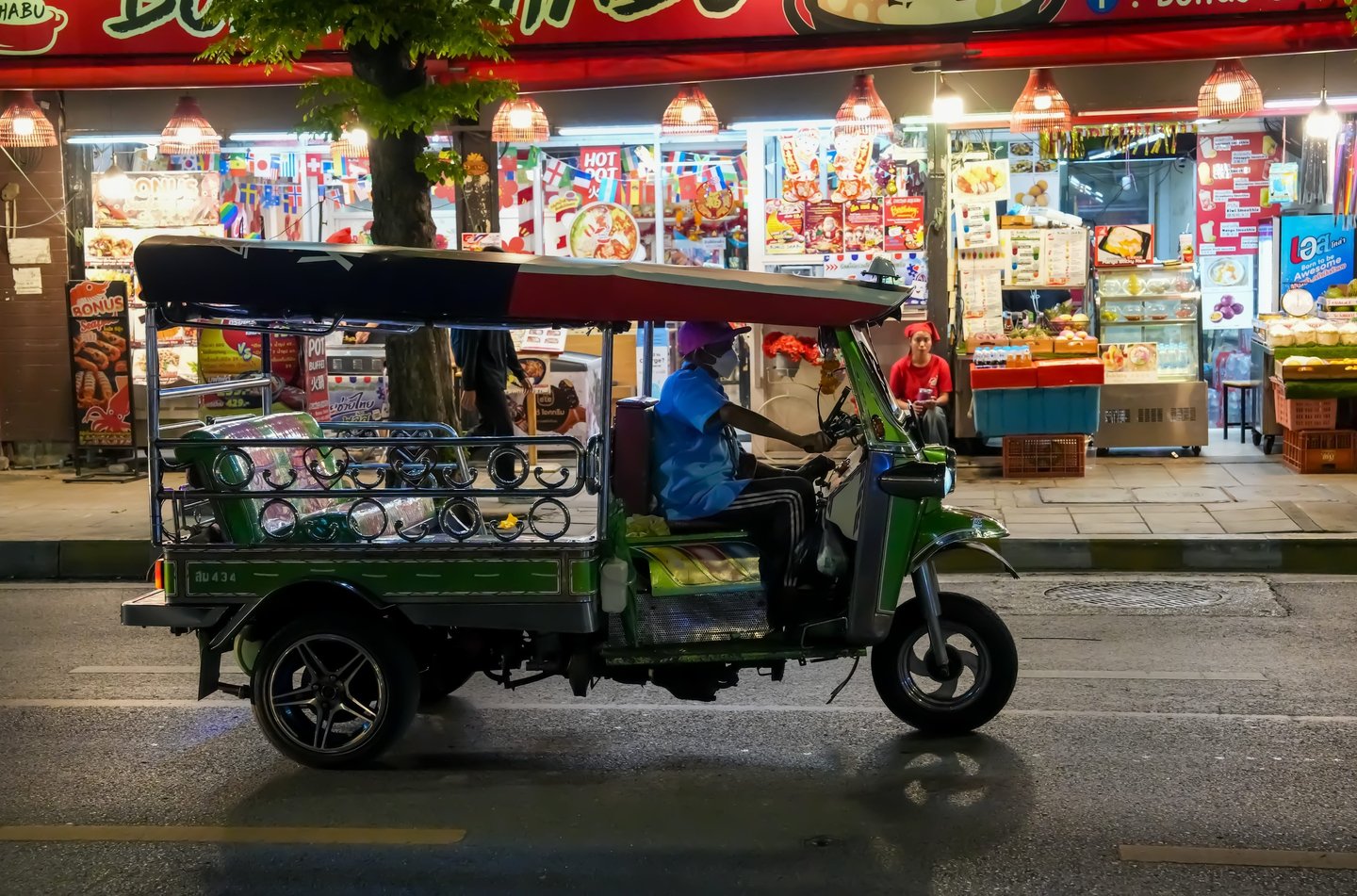
A green tuk-tuk stationary on a Bangkok street at night — driver in a blue shirt, purple cap, back compartment loaded with rolled mats and supplies, registration สม 434. Behind it a hot pot restaurant with international flags strung across the fascia, food display cases lit up, a woman in red sitting at the counter. A fruit and smoothie stall on the right. The full pavement scene of a Bangkok night street, compressed into one frame.
Nobody posed for this. The tuk-tuk just happened to stop in the right spot.
I shot this at 52mm on the Sony Alpha 7 IV with the FE 24-70mm f/2.8 GM II. f/5.6 to keep the tuk-tuk sharp front to back while the shopfronts behind it stay readable rather than blurring out. 1/320 — fast enough to freeze both the vehicle and the driver cleanly. ISO 12800 in the mixed neon and fluorescent light of a Bangkok night street. At ISO 12800 the A7 IV files are grainy but the colour holds and the shadow detail in the darker areas of the tuk-tuk bodywork is still recoverable. That's what matters when you're shooting handheld at this sensitivity level.
52mm is the right focal length for a scene like this — close enough to the natural perspective of the eye that nothing feels compressed or distorted. The tuk-tuk fills the lower half of the frame, the shopfront fills the upper half, and the wet road in the foreground reflects just enough of the neon to anchor the bottom of the image.
The tuk-tuk is Bangkok's most photographed vehicle and also its most overlooked working one. Tourists photograph them from the outside before getting in. The shot is from street level, at night, when they're just part of the traffic and nobody is paying attention.
Bangkok, Thailand
Sony Alpha 7 IV · FE 24-70mm f/2.8 GM II · 52mm · f/5.6 · 1/320s · ISO 12800
Soi Cowboy, Bangkok — I Asked Before I Shot. She Said Yes Without Hesitating.
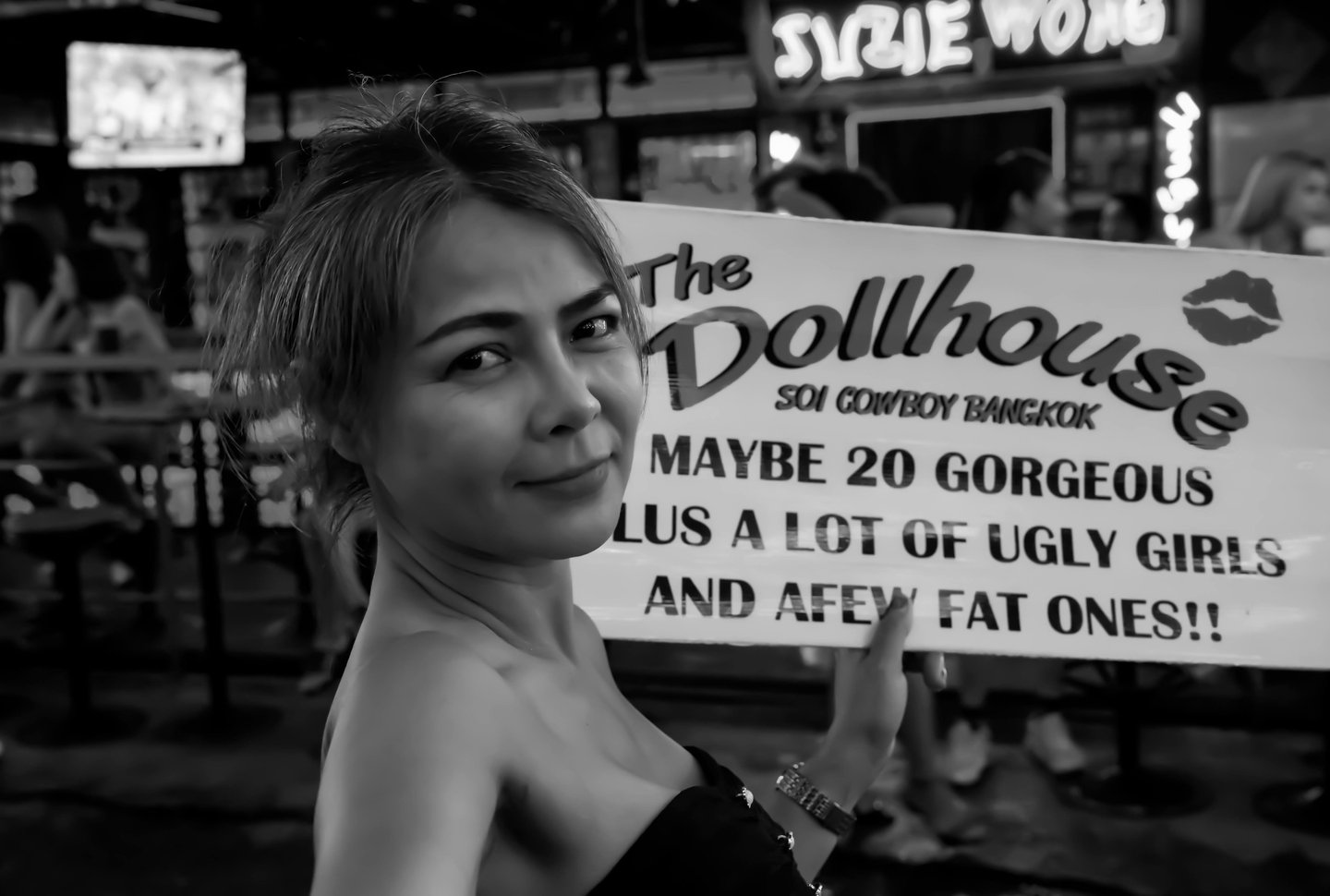
A woman holding The Dollhouse bar sign at the entrance to the bar on Soi Cowboy — black and white, shot at close range, her face turned sideways toward the camera with a quiet half-smile. The sign in her hands reads: "Maybe 20 gorgeous plus a lot of ugly girls and a few fat ones." The Suzie Wong neon sign glowing out of focus in the background. The bar strip running behind her.
I asked her before I raised the camera. She said yes immediately. No hesitation, no negotiation — she just held the sign the way she was already holding it and looked at me the way she was already looking. That's the photograph.
I shot this at 43mm on the Sony Alpha 7 IV with the FE 24-70mm f/2.8 GM II. f/6.3 to keep both her face and the sign text sharp simultaneously. 1/40 in the available bar light of Soi Cowboy at night — slow, but the subject was still and the A7 IV's stabilisation held it. ISO 5000, mixed neon and artificial light. Black and white was the only right call — colour would have pulled the eye to the bar signs and away from her face, which is where the photograph lives.
Soi Cowboy is one of Bangkok's three main adult entertainment districts, alongside Patpong and Nana Plaza. It runs off Sukhumvit between Sois 21 and 23 and has been operating since the early 1970s — originally serving American military personnel during the Vietnam War era. Today it's a mix of go-go bars, regular bars and restaurants, running every night of the week.
As a documentary photographer I'm not here to make a judgement on what happens on this street. That's not my job. My job is to document what's in front of me — honestly, with the consent of the people in the frame, and without editorialising what I see.
She works this street. She agreed to be photographed. That's the whole story.
Soi Cowboy, Bangkok, Thailand
Sony Alpha 7 IV · FE 24-70mm f/2.8 GM II · 43mm · f/6.3 · 1/40s · ISO 5000
Long Bien Bridge, Hanoi — They've Been Bombing This Bridge Since 1967 and It's Still Carrying the Rush
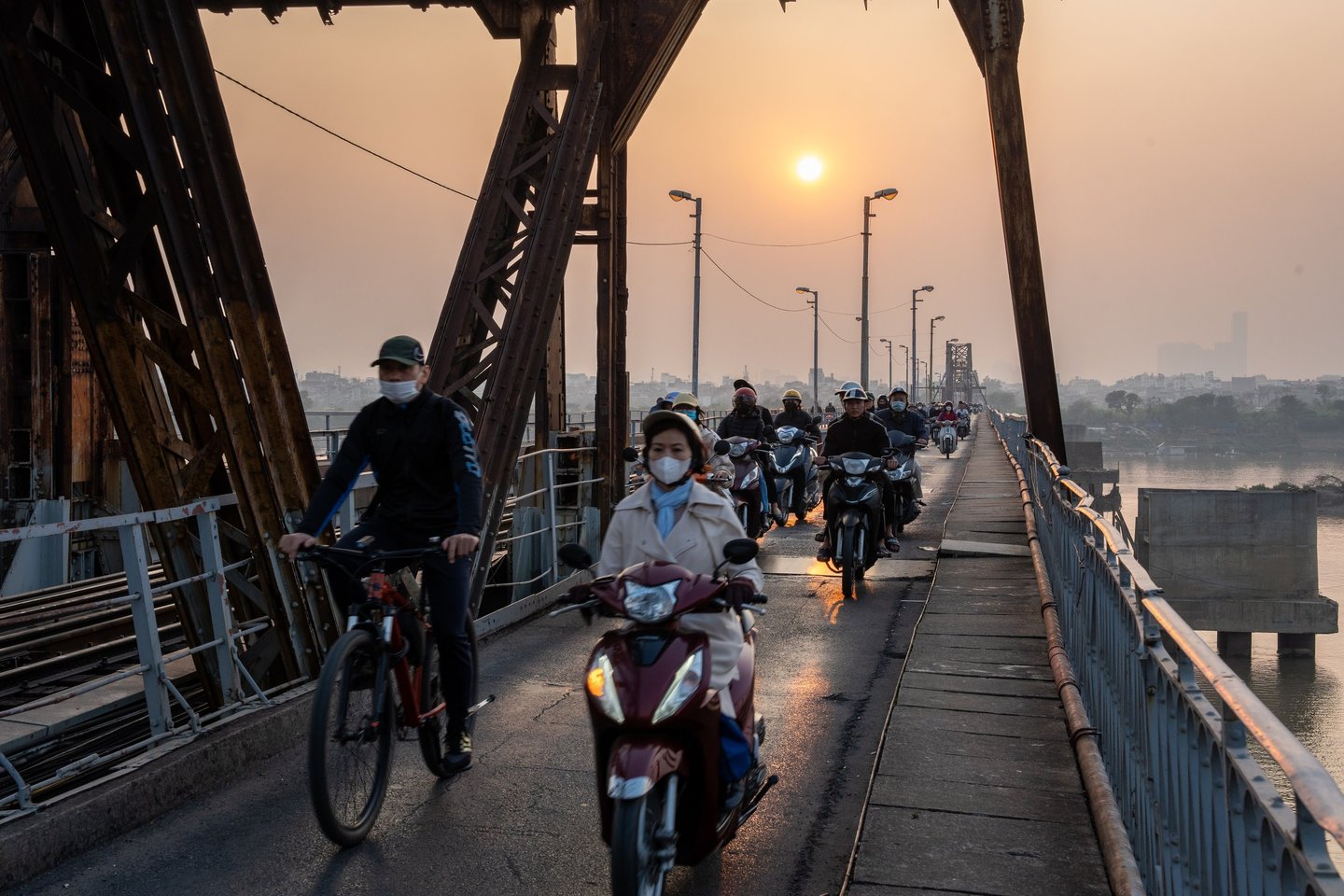
Motorbikes and a cyclist coming straight at the camera, the rusty steel trusses of Long Bien Bridge framing both sides of the frame, the sun sitting low and orange through the Northern Vietnam winter haze, a column of riders stretching all the way back to the far bank. Shot from the middle of the bridge deck at 50mm — standing my ground as the traffic came through.
We walked out from Hanoi railway station late afternoon and spent nearly three hours on this bridge. That's not a typo. Three hours — watching the light change, the traffic shift, the trains run underneath, and the sun drop through the smog until it turned the whole Red River orange.
Long Bien Bridge was built between 1899 and 1902 during the French colonial era, designed by French firm Daydé & Pillé and originally named the Paul Doumer Bridge. At over 2.2 kilometres it was one of the most ambitious engineering projects in Southeast Asia at the time. During the Vietnam War it became a primary target — American bombing runs destroyed sections of the span repeatedly between 1967 and 1972. Each time, Vietnamese workers patched it back together and kept it running. The repairs are still visible. Original French ironwork sits directly alongside raw industrial replacements that make no attempt to match what was there before. The bridge looks exactly like what it is — something that survived.
50mm on the Sony Alpha 7 IV with the FE 24-70mm f/2.8 GM II. f/13 to keep everything sharp from the riders in the immediate foreground all the way to the bridge structure disappearing into the haze on the far bank. 1/125 to hold the scene with the low available sunset light. ISO 500, clean files, the warm orange cast of the Northern Vietnam winter sky doing the colour work without any help.
Standing in the middle of moving traffic on a 120-year-old bridge at sunset is not something you plan. You just end up there and realise the frame is already built around you.
Long Bien Bridge, Hanoi, Vietnam
Sony Alpha 7 IV · FE 24-70mm f/2.8 GM II · 50mm · f/13 · 1/125s · ISO 500
Last Faces of the Night: Raw Street Photography on Soi Buakhao at 4:00 AM , Thailand Southeast Asia
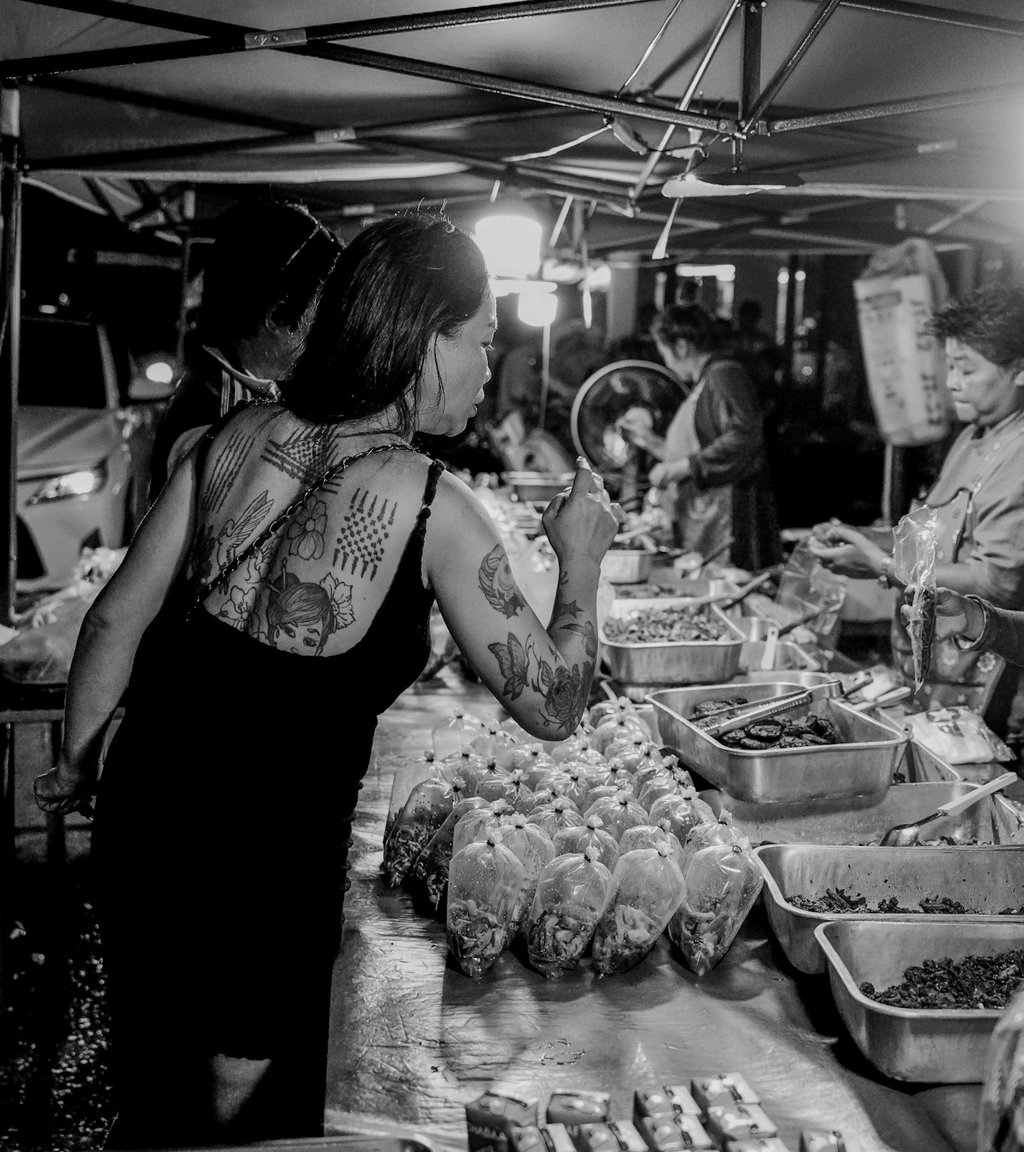
If you only know Pattaya in daylight, you don't know Pattaya at all. And if you only filter the city through flashy videos, neon lights, and bar scenes, you understand it even less. The next chapter of my series Black and White Photography in Southeast Asia – Night Street Photography between Light and Shadow documents the exact moment when the night begins to fade: Soi Buakhao in Pattaya City at 4:00 AM.
This unposed, high-contrast monochrome frame captures a slice of raw reality at a local Thai food stall beneath a canvas canopy. The composition anchors on a woman viewed from behind in a black strap dress, her back and arms heavily detailed with traditional tattoos (Sak Yant) and intricate artwork. She is gesturing toward the counter, where neatly arranged, air-filled plastic bags of food and metal trays filled with local dishes sit ready for the early morning. In the background, the stall owner works under the harsh glare of a bare lightbulb, while the front of a parked car emerges from the deep shadows on the left. It’s an honest slice of Thai daily life suspended between light, silence, and the last faces of the night.
For photography enthusiasts and content creators, shooting at this hour is a complete balancing act due to the extreme mixed lighting. To isolate the fine tonal gradations of the tattoos and the textures of the plastic bags without turning the shadows into digital mud, I relied heavily on my primary setup: the Sony Alpha 7 IV (ILCE-7M4) paired with the Sony FE 24-70mm f/2.8 GM II.
The 33-megapixel full-frame sensor of the Sony Alpha 7 IV delivers exceptional dynamic range, pulling clean details out of the dark alley corners without letting the file crumble into noise. Thanks to the optical engineering of the G Master lens, the fine lines of the artwork and the reflections on the plastic packaging remain pin-sharp even when shooting wide open, while the intense hotspot from the hanging bulb is kept firmly under control.
Calling all Pattaya, Thailand, and Southeast Asia experts: It’s during these quiet morning hours, when the nightlife noise finally dies down, that Soi Buakhao shows its real identity
Capturing the Golden Hour Smiles of Hoi An Ancient Town, Vietnam
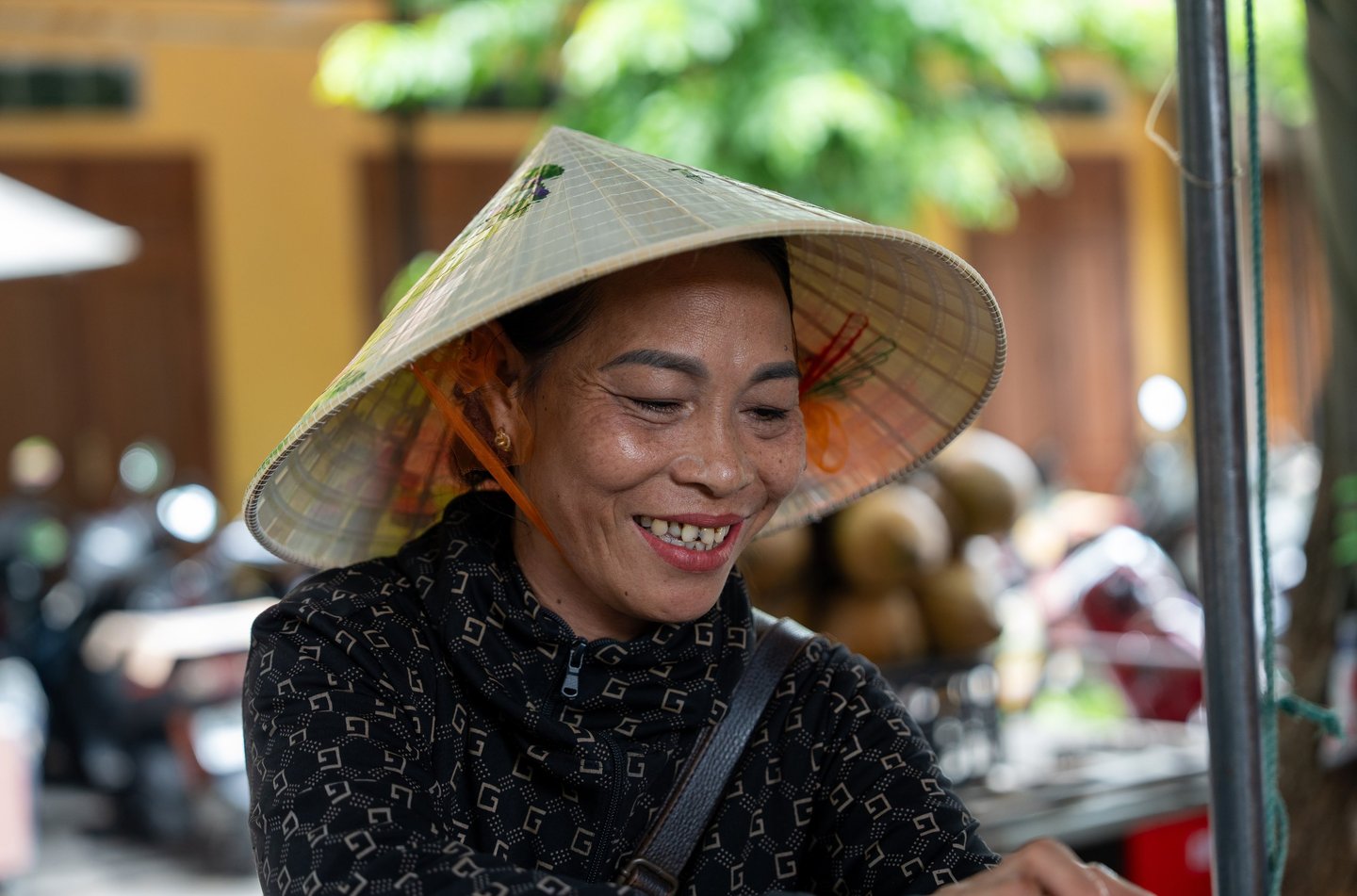
When the late afternoon sun hits the yellow historic facades of Hoi An Ancient Town, the light turns completely magical. For an unposed street and documentary photographer, this is the exact moment to look past the architecture and focus on the people who give this UNESCO World Heritage site its heartbeat.
This candid portrait captures a Vietnamese woman wearing a traditional conical hat (Nón Lá) smiling genuinely during a quiet afternoon moment. The warm daylight catches the rich, weathered textures of her hat and the natural expressions of her face, while the busy background of the historic ancient town blurs away into a smooth, soft texture.
To nail this shot without disrupting the natural flow of the moment, I relied heavily on my Sony Alpha 7 IV (ILCE-7M4) paired with the Sony FE 24-70mm f/2.8 GM II. I extended the focal length all the way to 70mm to create a tight, intimate frame from a respectful distance. Keeping the aperture wide open at f/2.8 allowed me to create a shallow depth of field, instantly separating her expressive features from the background distraction.
With an ISO of 400 and a shutter speed of 1/160s, the camera perfectly balanced the ambient daylight, keeping the skin tones incredibly accurate and the fine lines of her smile sharp. The lens choice proved its worth here—delivering tack-sharp details right where it counts while rendering the background bokeh smoothly.
Every night, this street fills up with more people than it was ever built to hold, Bangkok in Thailand
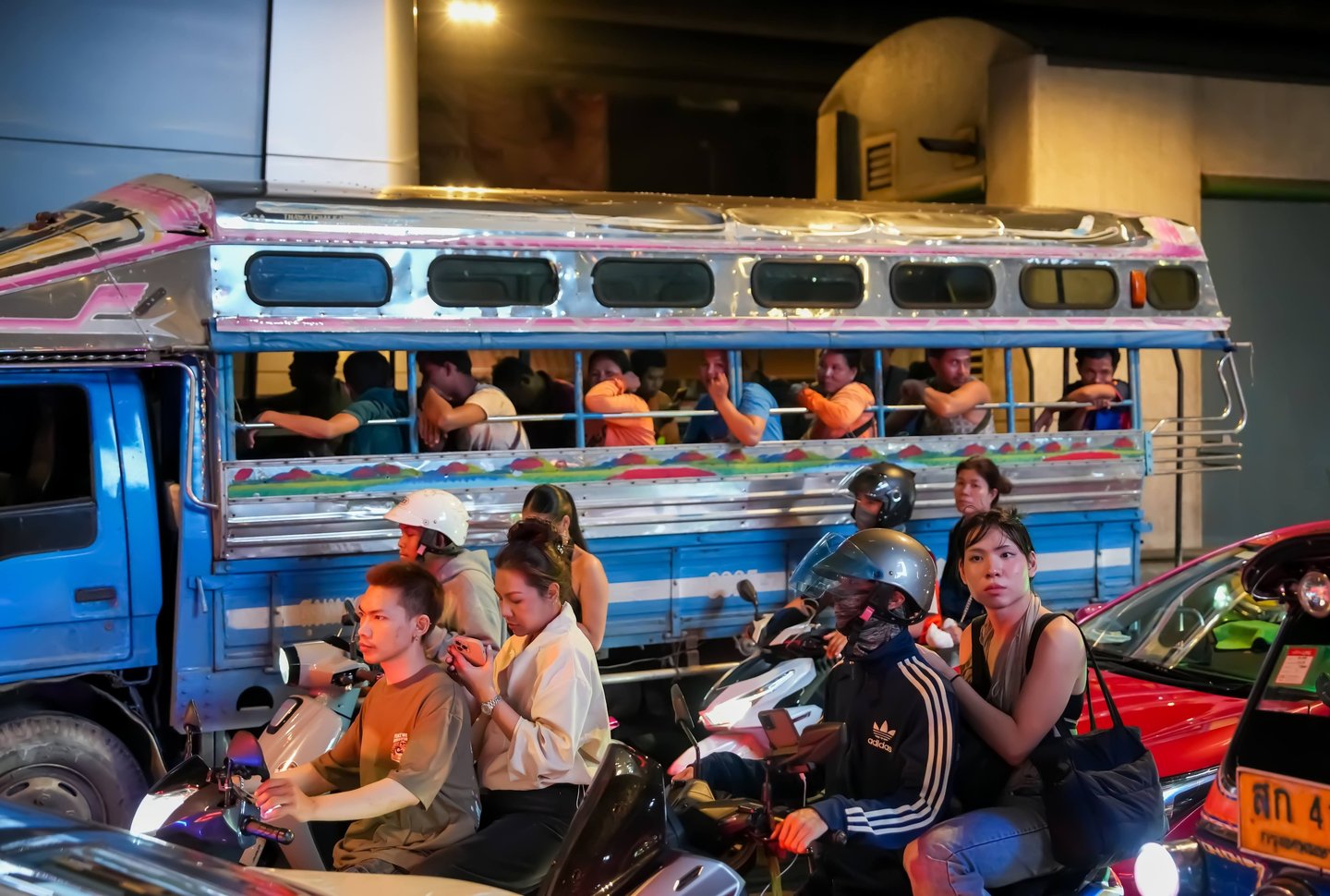
This is Sukhumvit 11 after dark, one of Bangkok's busiest nightlife corners, caught mid-traffic jam at a packed intersection. A hand-painted local bus, riders leaning out the open windows and packed shoulder to shoulder, sits stopped dead next to a wall of motorbikes — riders and passengers checking phones, watching the road, waiting for a gap in the gridlock that isn't coming any time soon. Every kind of transport Bangkok runs on is stacked into this one frame: the old-school bus, the scooters, a taxi's tail lights glowing red in the corner. This is what a Sukhumvit night actually looks like once the neon signs and the bar crowds spill out onto the street.
Here's why I set the camera the way I did. At night, in a crush of vehicles and neon signage with almost no clean light source, I opened up to f/2.8 to pull in as much light as the lens could gather — I needed that just to get a workable exposure without pushing ISO through the roof. 1/80 sec was as slow as I could go handheld at 70mm without risking blur, and even then it's right at the edge — any slower and the moving riders would have smeared. That combination still needed ISO 5000 to balance out, which in mixed streetlight and headlight glow like this is a completely reasonable trade-off — clean enough to hold detail in faces and signage, without needing to compromise on shutter speed or aperture.
70mm on the Sony FE 24-70mm f/2.8 GM II let me isolate the riders and the bus passengers from across the street, compressing the whole gridlocked scene into one tight, layered frame without me having to wade into the traffic myself.
Part of my ongoing series on Bangkok street photography and Southeast Asia nightlife — the traffic, the chaos, the everyday grind of getting around this city after dark. More Thailand travel photography on my page
Technical details:
Sukhumvit 11, Bangkok, Thailand. 1/80 sec, f/2.8, ISO 5000, 50 mm — Sony Alpha 7 IV with Sony FE 24-70mm f/2.8 GM II.
A pair of painted eyes on the bow, put there so the boat itself can see where it's going, Can Tho in Southern Vietnam
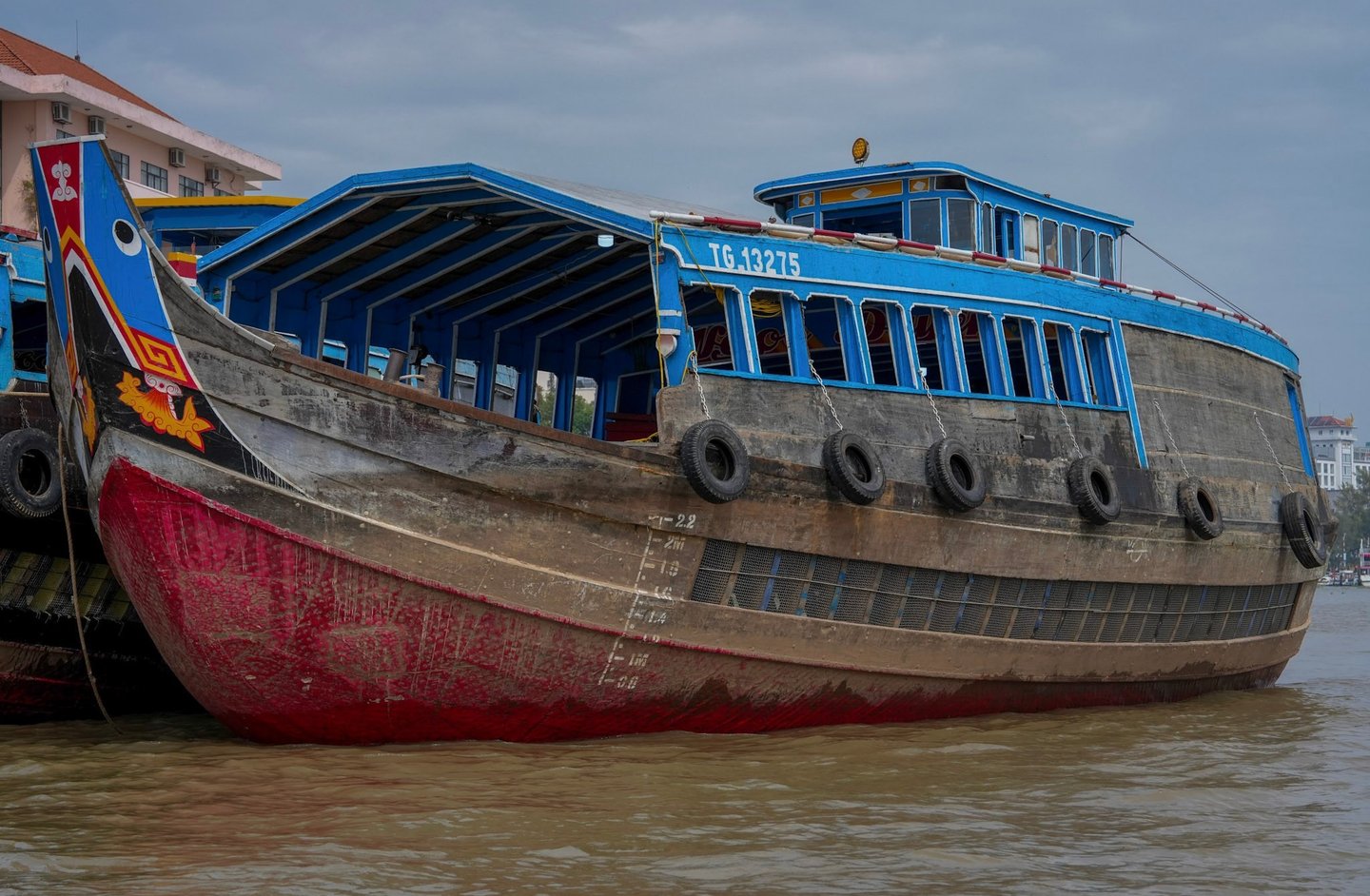
This wooden cargo boat is moored on the Hau River in Can Tho, the largest city in Vietnam's Mekong Delta and often called the delta's unofficial capital. Look closely at the bow and you'll see it — a painted design that follows an old regional tradition of giving new boats a pair of eyes during a launch ceremony, meant to protect the vessel and guide it safely through the water. Tucked between rows of truck tires used as fenders, with its registration number TG.13275 painted across the hull, this boat is a working vessel, not a showpiece — one of thousands that keep goods and produce moving through Can Tho's canals and river branches every day.
Can Tho sits on the Hau River, one of the main branches of the Mekong, and its entire identity is built around water — cargo boats like this one, the famous Cai Rang floating market just outside the city center, and canals that still move rice, fruit, and produce the way they have for generations. Standing at the waterfront, you get the full cross-section of that river economy in a single frame: old wooden hulls, painted bows, patched paint jobs, and boats stacked two and three deep along the bank.
Here's why I set the camera the way I did. Shooting straight into an overcast Mekong sky with a bright, pale background behind a dark wooden hull meant contrast was the real challenge, not motion. 1/3200 sec was faster than the scene technically required, but it gave me margin against any shift in the light without blowing out the sky. I closed down to f/7.1 for enough depth of field to keep the entire bow-to-stern length of the boat sharp, since the hull runs diagonally through the frame and a wider aperture would have left part of it soft. ISO 1000 balanced that out under the flat, cloudy daylight, keeping the exposure clean without needing to compromise on depth or shutter speed.
70mm on the Sony FE 24-70mm f/2.8 GM II let me isolate this single boat from the water traffic around it, compressing the hull and its details into one tight, readable frame.
Part of my ongoing series on Vietnam and Southeast Asia river life — the boats, the markets, the canals of the Mekong Delta. More Can Tho and Mekong Delta travel photography on my page
Technical details:
A cargo boat on the Hau River, Can Tho, Mekong Delta, Vietnam. 1/3200 sec, f/7.1, ISO 1000, 70mm — Sony Alpha 7 IV with Sony FE 24-70mm f/2.8 GM II.
Scooters, a tuk-tuk, and a taxi, all lined up waiting for the same green light.
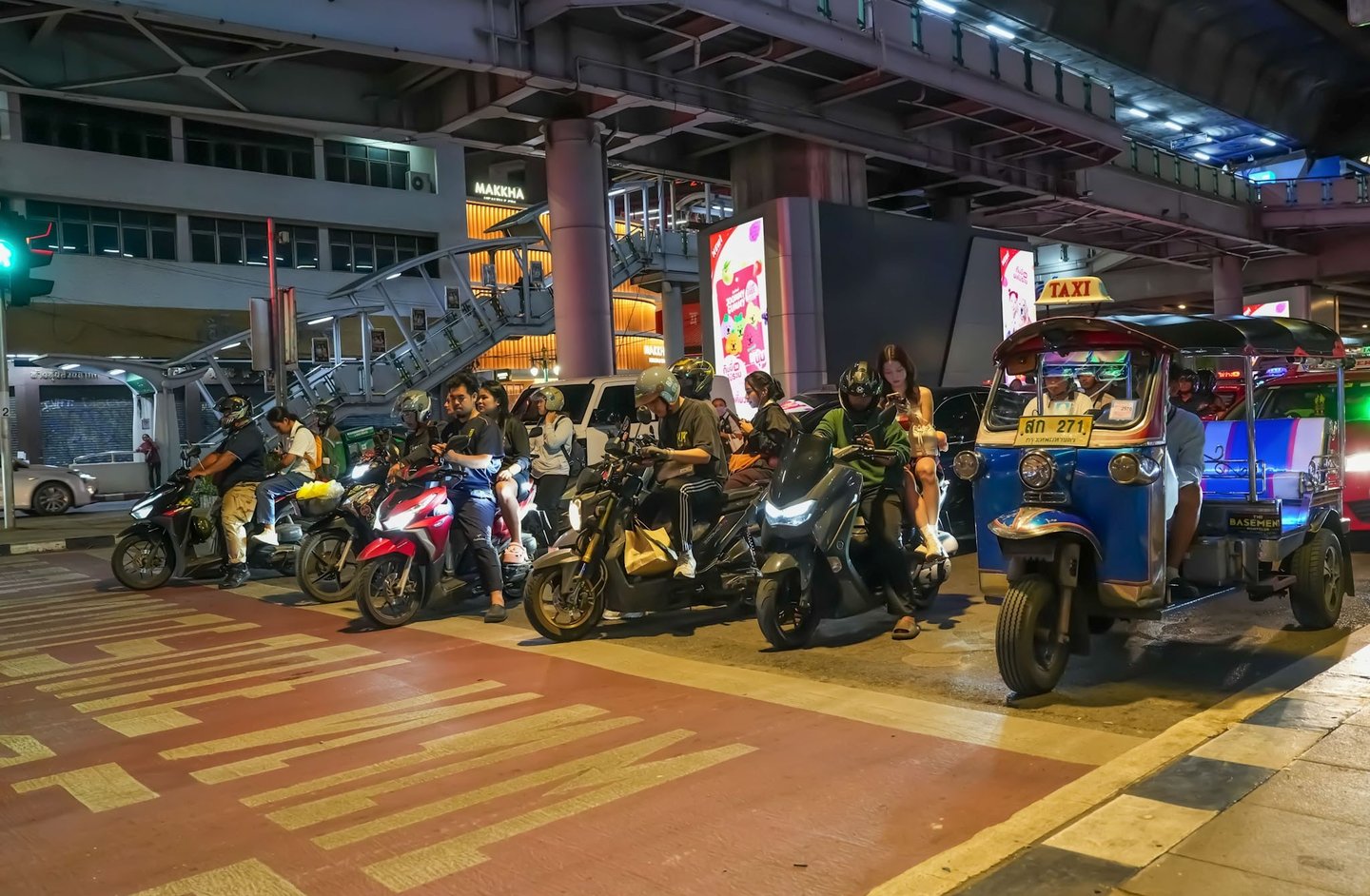
This is Sukhumvit 11 at night, one of Bangkok's busiest nightlife corners, caught in that few-second pause between the light turning green and the whole row of vehicles actually moving. Riders and passengers packed onto scooters, most of them checking phones while they wait, a classic blue-and-red tuk-tuk idling next to them, and a taxi's rooftop light glowing behind. Above it all, the elevated BTS station and its walkway loom over the intersection, steel and concrete stacked over a street that never actually stops moving, even when everyone in the frame is standing still.
This is the kind of scene that sums up getting around Bangkok after dark — every form of transport the city runs on, stacked into one intersection, all waiting on the same signal.
Here's why I set the camera the way I did. Night traffic scenes like this are almost entirely mixed lighting — LED signage, streetlights, headlights, shop lighting, none of it consistent. I opened up to f/5.0, wide enough to gather real light but still tight enough to hold focus across a wide row of riders stretching from one side of the frame to the other. 1/100 sec was the balance point — slow enough to keep ISO from climbing further, fast enough that the riders, mostly stationary but shifting slightly, stayed sharp rather than smearing. Even with that balance, ISO 5000 was necessary to pull a clean exposure out of a scene with almost no strong, even light source — a completely fair trade for holding onto detail on every rider's face and every reflection off the wet street.
28mm on the Sony FE 24-70mm f/2.8 GM II kept the frame wide enough to capture the entire row of vehicles and the elevated station towering above them, without losing the scale of the scene by zooming in too tight.
Part of my ongoing series on Bangkok street photography and Southeast Asia nightlife — the traffic, the tuk-tuks, the everyday grind of getting around this city after dark. More Thailand travel photography on my page
Technical details:
Sukhumvit 11, Bangkok, Thailand. 1/100 sec, f/5.0, ISO 5000, 28mm — Sony Alpha 7 IV with Sony FE 24-70mm f/2.8 GM II.
A glass tower catching the last light of the day, with all of Bangkok crammed into the frame beneath it.
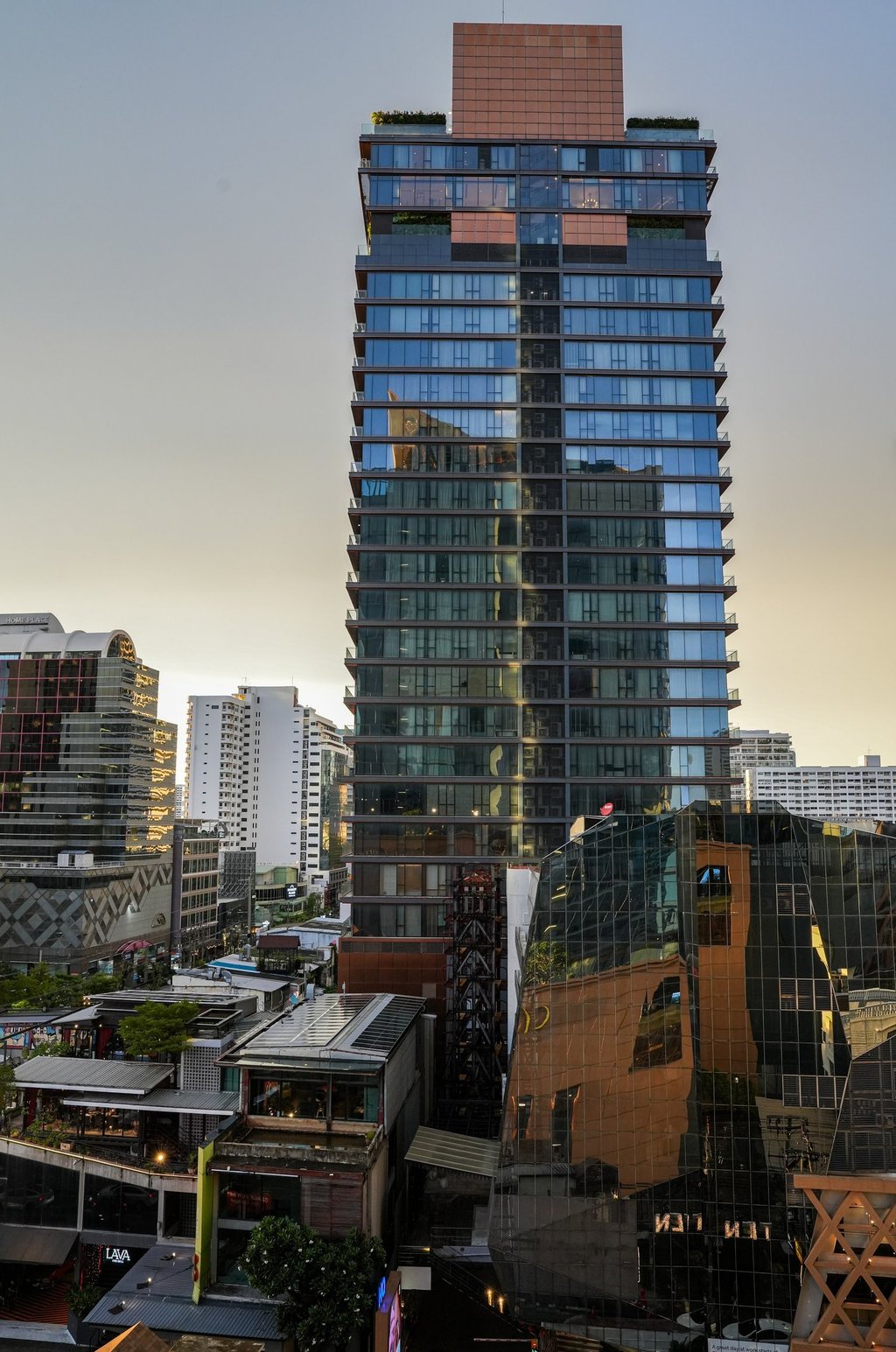
This is a residential high-rise in the Sukhumvit 55 area (Thonglor), shot from the pool terrace of the Grande Centre Point Hotel at dusk. The building's blue-glass facade catches the fading sunset light on one side while the rest of the tower slips into shadow, its rooftop terraces and copper-toned accents standing out against a soft, hazy Bangkok sky. Below it, the layered chaos of the city takes over — older low-rise shophouses, rooftop restaurants, tangled rooftop structures, and more glass towers stacked into the background, exactly the kind of vertical density that defines Sukhumvit.
Shooting from a hotel pool terrace gave me the elevation to actually separate this tower from the visual noise around it, looking straight up at a scene that would be impossible to frame from street level with everything else in the way.
Here's why I set the camera the way I did. Dusk light is fading fast and unevenly, so I closed down to f/8 to make sure both the tower's full height and the layered rooftops below it stayed sharp front to back — this is a deep scene with a lot happening at different distances, and a wider aperture would have softened part of it. 1/80 sec was slow enough to let in the fading light without a tripod, but still fast enough to keep everything steady handheld. That combination pushed ISO up to 1250 to balance the exposure — a completely reasonable trade at dusk, when the light is dropping by the minute and there's no getting around some compromise somewhere in the triangle.
26mm on the Sony FE 24-70mm f/2.8 GM II let me go wide enough to hold the full height of the tower along with the rooftop clutter below it, without needing to step back further than the terrace allowed.
Part of my ongoing series on Bangkok architecture and Southeast Asia skyline photography — the towers, the rooftops, the layers that make this city what it is. More Thailand travel photography on my page
Technical details:
Sukhumvit 55 (Thonglor), shot from the pool terrace of the Grande Centre Point Hotel, Bangkok, Thailand. 1/80 sec, f/8.0, ISO 1250, 26mm — Sony Alpha 7 IV with Sony FE 24-70mm f/2.8 GM II.
Under a string of bare bulbs, a street artist turns a blank page into a face you'd recognize anywhere.
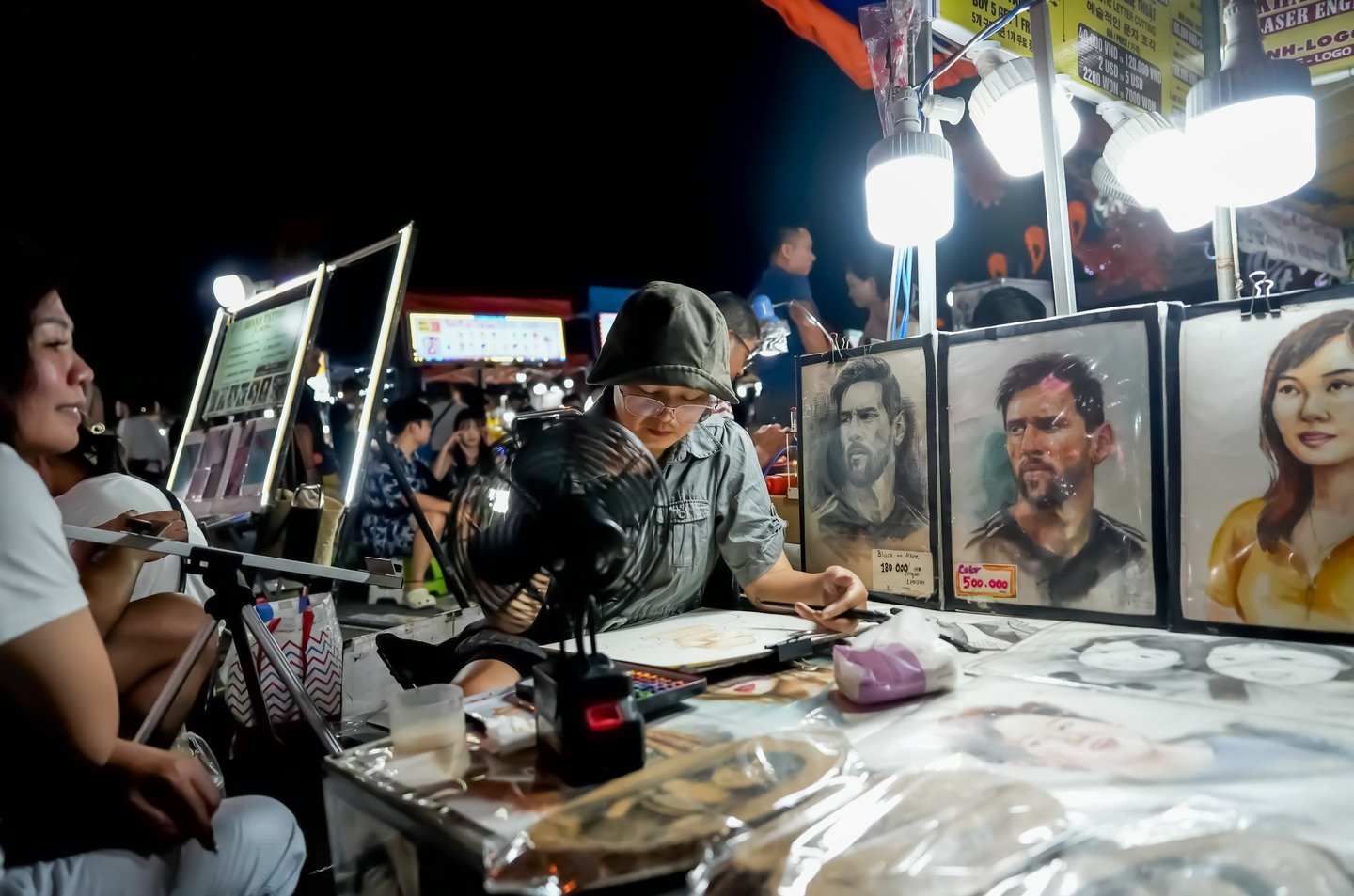
This is Son Tra Night Market in Da Nang, Vietnam, just steps from the Dragon Bridge on the Han River. Hundreds of stalls fill this stretch every evening from around 6 PM — street food, souvenirs, handicrafts — but it's the portrait artists tucked between them that stop people mid-walk. In this shot, an artist works under a rigged desk lamp and a small fan to fight the heat, sketching a fresh portrait while finished pieces hang clipped to a display board beside her: black-and-white and color portraits priced by the piece, including a striking likeness of Lionel Messi, the Argentine football legend, done in soft charcoal shading that pulls him right off the page.
That's what makes Da Nang's night markets worth slowing down for — it's not just shopping. Between the skewers and the sand paintings, you'll find working artists sketching live portraits by hand, on the spot, for whoever's willing to sit still for twenty minutes. On weekends the Dragon Bridge itself puts on its own show a short walk away, breathing fire and mist over the Han River at 9 PM, so a night here easily turns into market, portrait, bridge show, all in one loop.
Here's why I set the camera the way I did. Night markets like this run on messy, inconsistent light — bare bulbs, string lights, neon signage, all fighting each other. I opened all the way to f/2.8 to pull in as much of that light as possible. 1/2500 sec was faster than the scene needed for a mostly still subject, but with a market this crowded, someone's always stepping through the frame, and I wasn't giving up a clean shot to a stray elbow or a passing shopper. Even wide open, ISO 5000 was necessary to get a workable exposure out of a scene this uneven — a fair trade for holding onto the detail in both the artist's face and the portraits behind her.
24mm on the Sony FE 24-70mm f/2.8 GM II kept the frame wide enough to hold the artist, her workspace, and the full row of portraits in one shot, without losing the context of the crowded stall around her.
Part of my ongoing series on Vietnam and Southeast Asia street life — the markets, the artists, the everyday scenes that make a city's nightlife what it is. More Da Nang travel photography on my page
Technical details:
Son Tra Night Market, near Dragon Bridge, Da Nang, Vietnam. 1/2500 sec, f/2.8, ISO 5000, 24mm — Sony Alpha 7 IV with Sony FE 24-70mm f/2.8 GM II.
Neon pink under the hood, chrome speaker rings glowing like a nightclub, and the word "BEER" lit up front and center — this tuk-tuk means business, Chiang Mai in Thailand
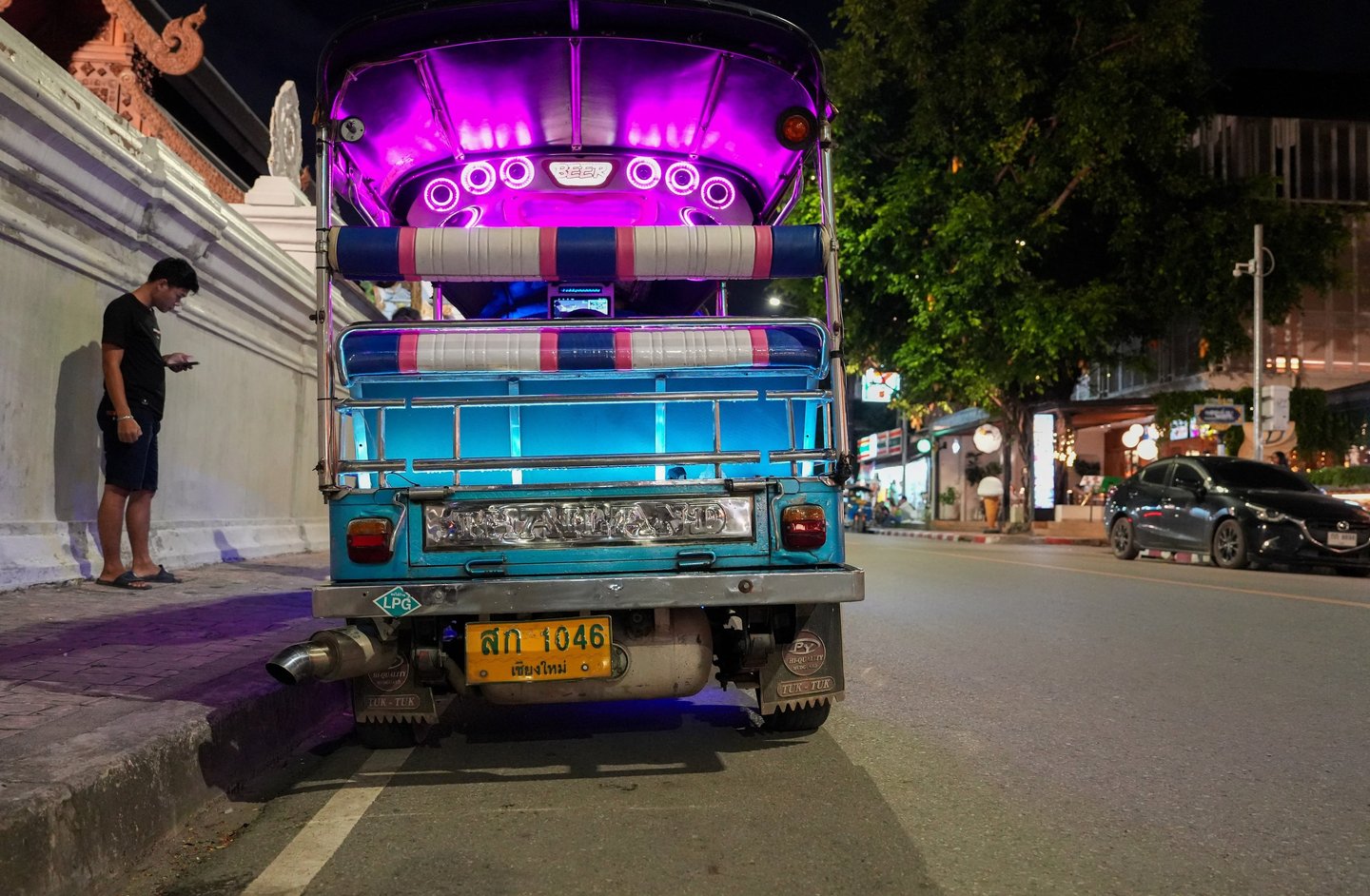
This is a customized tuk-tuk parked along the old city wall in Chiang Mai, Thailand, its entire rear canopy rigged with purple LED strip lighting and ring-lit speakers, blue under-glow spilling across the tailgate and license plate. Thai tuk-tuks get personalized like this all over the country, but Chiang Mai's tuk-tuk culture has its own flavor — drivers turning their rides into rolling light shows, sound systems built in, chrome polished to catch every bit of neon from the street around them. Behind it, the weathered stone and gilded roofline of one of Chiang Mai's old city temples sits in quiet contrast, a reminder that this city runs on both centuries-old tradition and after-dark street energy at the same time. A young guy leans against the temple wall checking his phone, completely unfazed by the glowing spectacle parked a few feet away — just another night in Chiang Mai.
Here's why I set the camera the way I did. Shooting a scene built almost entirely out of colored LED lighting against a dark night sky meant working with a huge range of brightness in one frame — glowing purple and blue against near-total black in the background. I opened to f/3.5 to pull in enough of that ambient light without collapsing depth of field completely, since I still wanted the temple wall on the left and the street scene behind the tuk-tuk to read clearly. 1/60 sec was slow enough to gather that neon glow properly but still fast enough to avoid blur from the person in frame. Even wide open, ISO 6400 was necessary — a scene lit only by colored LEDs and streetlights doesn't leave much room to keep noise down, and holding onto the actual color and detail in that lighting mattered more here than a cleaner file.
27mm on the Sony FE 24-70mm f/2.8 GM II let me stay wide enough to hold the full tuk-tuk, the temple wall, and the street scene beyond it all in one frame, without losing the scale of the whole setup.
Part of my ongoing series on Chiang Mai and Thailand street photography — the tuk-tuks, the temples, the everyday scenes that make this city what it is after dark. More Thailand travel photography on my page
Technical details:
A customized tuk-tuk along the old city wall, Chiang Mai, Thailand. 1/60 sec, f/3.5, ISO 6400, 27mm — Sony Alpha 7 IV with Sony FE 24-70mm f/2.8 GM II.
Chrome and Neon: A Tuk-Tuk Cuts Through Bangkok's Night Traffic


Purple LED lighting under a mirrored canopy, a pink bucket swinging off the back bumper, and a driver in a red shirt navigating it all through Bangkok traffic like it's just another Tuesday.
This is a customized tuk-tuk shot from behind in Bangkok, Thailand at night — its entire canopy lined with purple and blue LED strips reflecting off polished chrome, tail lights glowing red, a yellow Bangkok license plate lit up beneath a swinging pink bucket and exhaust pipe. Cars and motorbikes crowd the road ahead, headlights and taillights streaking through the frame, an elevated expressway looming in the background. Tuk-tuks like this are rolling proof that Bangkok's street culture never does anything halfway — even a three-wheeled taxi gets the full neon treatment.
What pulled me into this shot was the layering of color against the plain chaos of night traffic behind it — this one vehicle glowing like a nightclub while everything around it moves at the ordinary, exhausted pace of a Bangkok evening commute.
Here's why I set the camera the way I did. Shooting a moving subject at night with strong colored lighting meant working fast and wide open. f/2.8 pulled in as much of that LED glow as possible while still giving me enough separation between the tuk-tuk and the traffic behind it. 1/500 sec was fast enough to freeze the tuk-tuk completely despite it moving through traffic, no blur on any of the reflective chrome details. That shutter speed at night demanded ISO 5000 — a fair trade for holding onto every bit of color in the LED lighting instead of losing it to a slower, blurrier shot.
48mm on the Sony FE 24-70mm f/2.8 GM II let me stay far enough back in traffic to frame the whole tuk-tuk while compressing it slightly against the cars behind it.
Part of my ongoing series on Bangkok street photography and Southeast Asia nightlife. More Thailand travel photography on my page
Technical details:
A customized tuk-tuk in traffic, Bangkok, Thailand. 1/500 sec, f/2.8, ISO 5000, 48mm — Sony Alpha 7 IV with Sony FE 24-70mm f/2.8 GM II.
When a Vintage Plane Lands on a Bangkok Night Market


Some places are photographed for what they are. Others make you stop because you simply don't expect to find them there.
This frame comes from Rod’s Moto Cafe at the Train Night Market Srinagarindra, also known as Talad Rot Fai Srinakarin in Bangkok. Above the small vintage-style café sits an old aircraft, its wings stretching across the dark Bangkok sky. Below it, petrol pumps, a Volkswagen van, colourful neon lights and the café itself create a scene that looks more like an old American roadside stop than a night market in Thailand.
That contrast is exactly what caught my attention as a travel photographer exploring Bangkok and Southeast Asia. The Srinagarindra Train Night Market is known for vintage finds, street food, bars and its strong retro atmosphere. But for me, photography here is less about documenting the market itself and more about noticing the unexpected details within it.
I stayed at 24mm because I wanted the entire structure in the frame. The wide perspective lets the aircraft dominate the upper part of the photograph while keeping Rod’s Moto Cafe, the vintage petrol pumps and the surrounding night atmosphere visible below.
At f/3.2, I could gather enough light without completely losing the separation between the café and the dark background. 1/50 sec was a deliberate compromise: slow enough to work with the limited available light, but still fast enough for a handheld frame. ISO 5000 brought the exposure up while retaining the colours and atmosphere of the neon lighting.
This is the kind of scene I look for when travelling through Thailand — something that doesn't fit the usual picture of Bangkok, but tells you something about the city's constantly changing visual character.
📍 Train Night Market Srinagarindra (Talad Rot Fai Srinakarin), Bangkok, Thailand
📷 Sony Alpha 7 IV · FE 24–70mm f/2.8 GM II · 24mm · f/3.2 · 1/50s · ISO 5000
Bangkok’s Other Highway: Life Along Khlong Saen Saep


Forget the traffic for a moment. Some of Bangkok’s most interesting journeys happen on the water.
This photograph was taken along Khlong Saen Saep, one of Bangkok’s historic waterways and still an important transport route through the city. The orange express boat cuts across the frame beneath a pedestrian bridge, while older riverside buildings stand almost directly over the canal. The red-and-white markings on the bridge show the clearance the boats need to pass underneath. The scene is busy, practical and completely ordinary for the people who use this route every day. The canal boat service has operated since 1990 and remains a useful way to cross parts of Bangkok without getting caught in road traffic.
This is the side of Bangkok travel photography I enjoy most. There is no famous landmark here and no carefully arranged view. Instead, the photograph shows how the city actually works — boats, bridges, ageing buildings and water all occupying the same narrow space.
From a photographer’s point of view, timing was important. I used 61mm to compress the scene slightly and bring the boat closer to the bridge and riverside architecture. 1/320 sec was fast enough to freeze the moving boat and the spray thrown up behind it. I chose f/4.5 to keep the boat and much of the background clearly defined while still giving the image some separation. With plenty of daylight available, ISO 200 kept the image clean and preserved detail in the buildings and water.
After years of travelling through Thailand and Southeast Asia, I have learned that these everyday scenes often tell me more about a city than its postcard views. This is Bangkok from water level — working, weathered and constantly moving.
📍 Location: Khlong Saen Saep, Bangkok, Thailand
📷 Sony Alpha 7 IV · Sony FE 24–70mm f/2.8 GM II
⚙️ 61mm | f/4.5 | 1/320 sec | ISO 200
Contact
Fuel my creativity, If you enjoy my content, feel free to support me with a small tip. Thanks for being part of this journey!
If you enjoy my photography and the stories I capture across Southeast Asia, consider supporting my journey. Every coffee helps me stay on the road longer and document more unique locations. Thank you for being part of the adventure!
Traveling across Southeast Asia, I’ve found that having an eSIM ready the moment you land is an absolute game-changer. I highly recommend Saily – I’ve had a great experience with them myself. It offers unbeatable advantages, especially for ordering a Grab taxi right away or using Google Maps to find your way as soon as you exit the airport
This post contains affiliate links for Saily. If you sign up through my link, I may earn a small commission at no extra cost to you. I only recommend services like Saily because I use them personally and they’ve made my travels much easier.
You can license my photography directly through my Alamy portfolio. My work covers authentic travel and street photography across Southeast Asia — Bangkok, Ho Chi Minh City, and the wider region — shot on location, not staged.
Looking for street scenes, urban editorial content, or landscapes from Thailand and Vietnam? My full collection is on Alamy, with licensing options from standard editorial to extended commercial rights, depending on what your project needs.
Disclosure: the link below is an affiliate link. If you license an image through it, I earn a share of the sale at no extra cost to you. It goes straight back into keeping me on the road and shooting across Southeast Asia.
© 2025 Strangphotography – Southeast Lens. All rights reserved.
All photos taken by me in public spaces. Licensing available via Alamy.
Unauthorized use prohibited. For full legal info, see my Imprint